
Introduction
Modern businesses depend on more than human users.
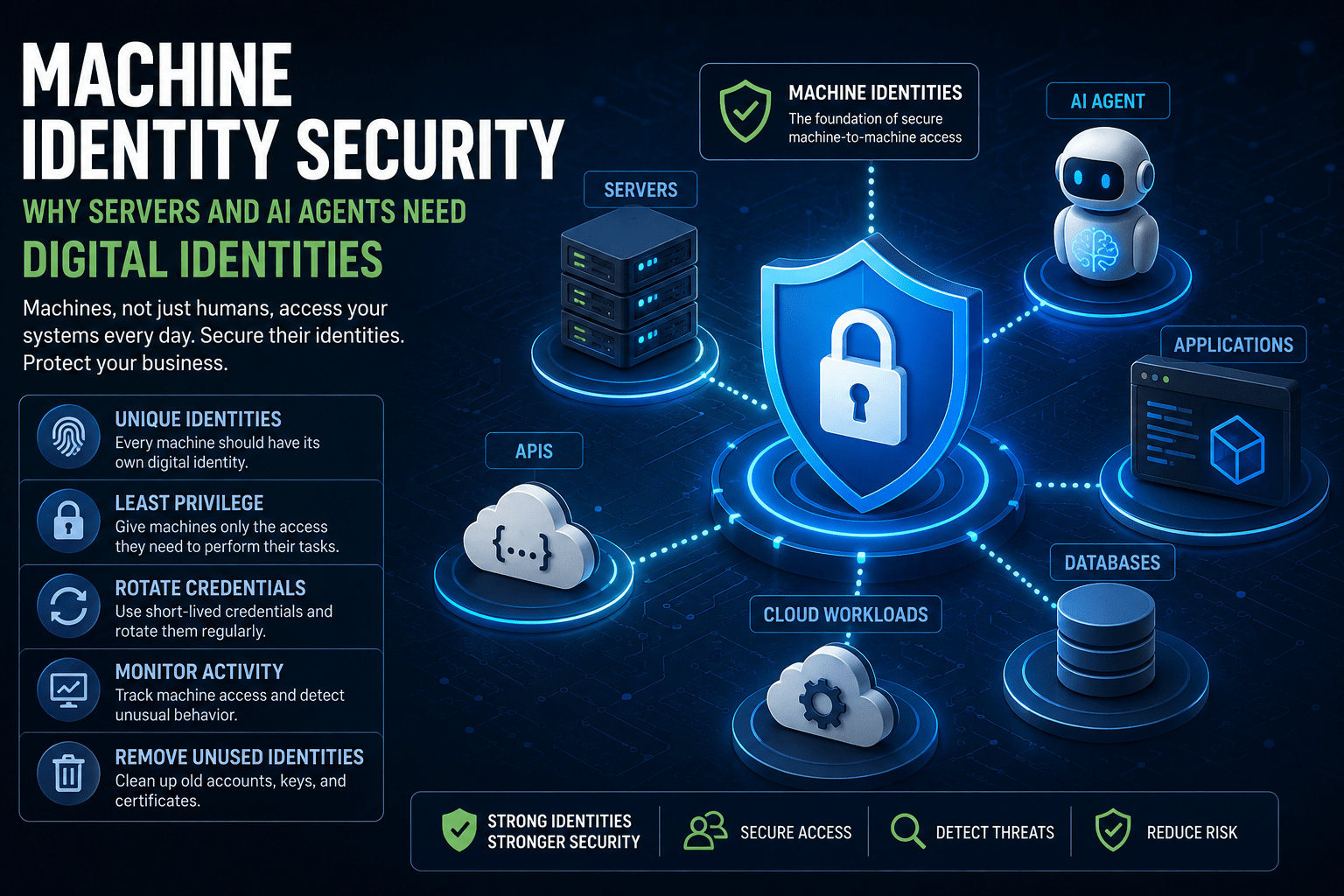
Servers run applications. APIs exchange data. Cloud workloads process information. Automated systems perform tasks without human involvement.
Now, AI agents can also access tools and services on behalf of users.
All these systems need a way to prove who they are. This is where machine identity security becomes important.
Machine identities help systems authenticate themselves. However, poorly protected machine identities can also create serious cybersecurity risks.
What Is a Machine Identity?
A machine identity is a digital identity that allows a machine, application, server, or automated workload to prove who it is.
For example, an application may need to access a database.
The database should not automatically trust every application that sends a request. Instead, it can check the application’s identity before allowing access.
A simple process looks like this:
Application → Identity → Verification → Permission check → Access
This process helps organizations control machine-to-machine communication.
Why Do Machines Need Digital Identities?
Modern applications use many connected services.
For example, an online shopping platform might use:
Website → API
API → Product Database
API → Payment Service
API → Cloud Storage
Each service needs a secure way to identify the system making the request.
A machine identity provides that connection.
As a result, security teams can control access without giving applications human usernames and passwords.
How Does Machine Authentication Work?
A machine can prove its identity in several ways.
Common methods include:
- Digital certificates
- API keys
- Access tokens
- Cryptographic keys
- Service accounts
- Cloud identities
The exact method depends on the application and infrastructure.
For example, one service might use a certificate while another uses a short-lived access token.
Regardless of the method, the goal remains the same:
Prove the identity before granting access.
Machine Identity vs Human Identity
Machine identities and human identities serve different purposes.
| Human Identity | Machine Identity |
|---|---|
| Belongs to a person | Belongs to a machine or application |
| Used by employees or customers | Used by systems and workloads |
| Often uses passwords or passkeys | Often uses keys, tokens, or certificates |
| Person interacts with the account | System uses the identity automatically |
| Example: Employee account | Example: Server identity |
Both types need strong authentication.
However, machines often make requests automatically and continuously. Therefore, organizations need automated controls to manage them.
What Happens When Machine Identities Are Poorly Managed?
Poor identity management can create several security problems.
For example, an organization might use the same credential across multiple applications.
An attacker who steals that credential could then access several systems.
Similarly, an old service account might remain active even after the application stops using it.
Other common problems include:
- Exposed API keys
- Shared credentials
- Excessive permissions
- Expired certificates
- Long-lived credentials
- Unused service accounts
- Poor monitoring
Consequently, machine identity security requires regular reviews.
Why Are Long-Lived Credentials Risky?
Some systems use credentials that remain valid for months or years.
That approach can increase the impact of credential theft.
Imagine a server uses the same access key for two years.
An attacker eventually obtains the key.
The attacker may continue using it until the organization detects the problem and disables it.
Short-lived credentials can reduce this risk.
For this reason, organizations should use temporary credentials when their systems support them.
Why Least Privilege Matters
A machine should receive only the permissions it needs.
Consider an application that only reads customer information.
It does not need permission to delete the entire database.
If the application receives unnecessary permissions, attackers may gain more control after stealing its credentials.
Therefore, organizations should follow the principle of least privilege.
In simple terms:
Give each machine only the access required for its job.
Why AI Agents Need Machine Identities
AI agents make machine identity security even more important.
An AI agent can perform tasks and interact with external systems.
For example, an AI agent might:
- Search company documents
- Access an internal database
- Call an API
- Create a support ticket
- Update business records
- Use cloud services
To perform these tasks, the agent needs an identity.
However, organizations should not give an AI agent unlimited access.
Instead, they should control exactly what the agent can access and what actions it can perform.
What Happens If an AI Agent Identity Gets Compromised?
Imagine an AI agent has access to customer records and internal APIs.
An attacker compromises the agent’s credentials.
The attacker may then attempt to use the same access.
The potential damage depends on the permissions assigned to the agent.
Therefore, organizations should combine strong identity controls with limited permissions and activity monitoring.
Common Machine Identity Security Mistakes
Sharing One Identity
Several applications may use the same credentials.
As a result, security teams cannot easily determine which application performed an action.
Giving Too Much Access
A machine may receive permissions that it does not need.
This creates unnecessary risk.
Keeping Old Accounts Active
Unused identities can become forgotten attack paths.
Regular reviews can help find them.
Using Long-Lived Credentials
Long-lived credentials give attackers more time to use stolen access.
Ignoring Machine Activity
Without proper monitoring, suspicious machine behavior may remain unnoticed.
How Can Organizations Protect Machine Identities?
Fortunately, organizations can follow several practical steps.
1. Give Each Machine a Unique Identity
Whenever possible, assign separate identities to different applications and workloads.
This makes access control and investigation easier.
2. Use Least Privilege
Limit each identity to the permissions it needs.
For example, a reporting service may only need read access.
3. Rotate Credentials
Replace important keys, certificates, and credentials regularly.
Also, revoke them quickly after a suspected leak.
4. Prefer Short-Lived Credentials
Temporary credentials reduce the time available to attackers if someone steals them.
5. Monitor Identity Activity
Track which machines access sensitive resources.
Furthermore, investigate unusual behavior quickly.
6. Remove Unused Identities
Review old service accounts, certificates, keys, and tokens.
If an identity no longer serves a purpose, disable or remove it.
7. Separate Environments
Keep development, testing, and production identities separate.
This approach limits the impact of an accidental credential leak.
Machine Identity Security in Cloud Environments
Cloud platforms can contain thousands of machine identities.
Applications, containers, serverless functions, APIs, and automated workloads constantly communicate with one another.
Consequently, organizations need strong identity controls across their cloud infrastructure.
Security teams should regularly ask:
Which system is accessing this resource?
Which identity does it use?
What permissions does it have?
Does it still need those permissions?
These questions can reveal unnecessary access.
How Can Teams Detect a Compromised Machine Identity?
Monitoring can help identify unusual activity.
Security teams can watch for:
- Unexpected locations
- Unusual request volumes
- New resource access
- Sudden permission changes
- Repeated authentication failures
- Activity outside normal patterns
For example, an application that normally accesses one database suddenly starts accessing several sensitive systems.
That change deserves investigation.
Therefore, identity security should include both access controls and monitoring.
Machine Identity Security Checklist
Organizations can use this checklist:
- Create unique machine identities.
- Apply least privilege.
- Protect API keys and certificates.
- Use short-lived credentials.
- Rotate credentials regularly.
- Monitor machine activity.
- Remove unused identities.
- Separate development and production access.
- Review permissions regularly.
- Limit AI agent access.
- Revoke compromised credentials quickly.
These steps can reduce the risks associated with machine identities.
Why Machine Identity Security Matters
The number of machine-to-machine connections continues to grow.
Cloud applications communicate with APIs. Microservices communicate with databases. Automated tools access business systems. AI agents interact with applications and services.
Therefore, organizations cannot protect their infrastructure by securing human accounts alone.
They also need to protect the identities operating behind the scenes.
A stolen machine credential can provide an attacker with valuable access. However, strong identity controls can limit that access and make suspicious activity easier to detect.
Final Thoughts
Machine identities allow servers, applications, APIs, cloud workloads, and AI agents to prove who they are.
They form an important part of modern digital infrastructure.
However, every machine identity creates an access point that organizations must manage.
Strong machine identity security requires unique identities, least privilege, credential rotation, short-lived access, monitoring, and regular reviews.
Most importantly, organizations should know which machine identities exist and what each one can access.
The key lesson is simple:
Machines need identities too, and those identities need protection.
As cloud computing, automation, and AI continue to grow, machine identity security will become an even more important part of cybersecurity.