
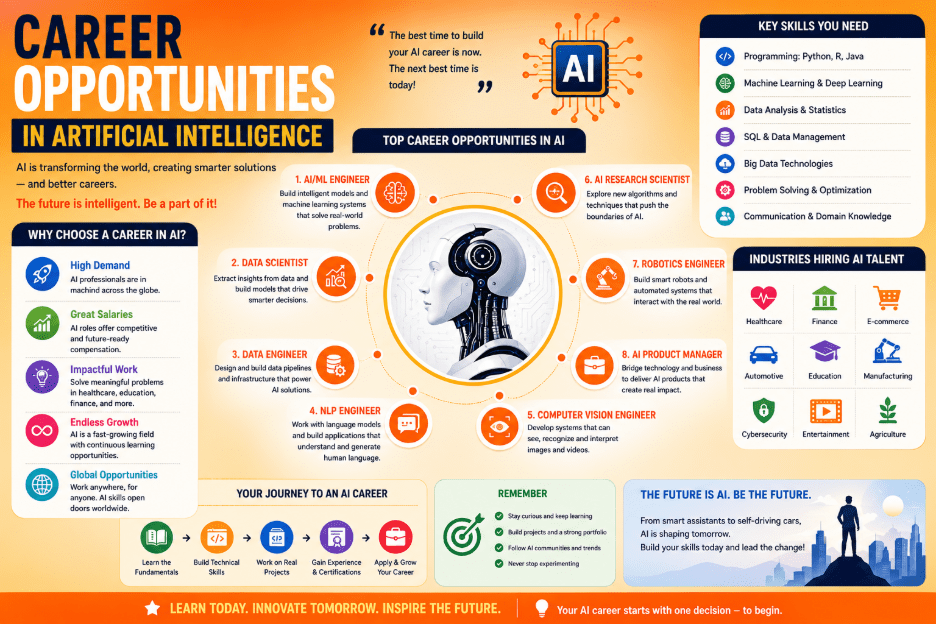
Artificial intelligence careers have moved out of research labs and into everyday business. Hospitals use AI to read scans. Banks use it to catch fraud. Retailers use it to predict what you will buy next.
Behind every one of these systems sits a team of trained professionals who design, build, test, and maintain the technology.
If you’re wondering whether a career in artificial intelligence is worth pursuing, the short answer is yes. The long answer is what this article covers.
This guide walks through the most in-demand artificial intelligence careers, the skills employers actually look for, expected salary ranges, and the steps you can take right now to enter the field — whether you’re a student, a working professional planning a switch, or an institution shaping its curriculum.
Why Artificial Intelligence Careers Are Growing So Fast
A decade ago, artificial intelligence was a niche subject taught in a handful of computer science departments. Today it sits at the centre of nearly every industry.
Job postings mentioning artificial intelligence have climbed sharply over the past three years. Companies now pay a premium for candidates who bring proven AI skills to the table.
A few forces are driving this surge:
- Data is abundant. Every click, transaction, and sensor reading generates data — and AI turns that raw material into useful predictions.
- Computing power is cheaper. Training a model that once required a specialised lab can now happen on cloud infrastructure available to almost anyone.
- Business adoption has widened. AI is no longer confined to tech companies. Healthcare, finance, manufacturing, agriculture, retail, and government all now run AI-driven projects.
- Talent supply hasn’t caught up. Universities and training institutes are producing graduates, but hiring demand is outpacing skilled output — which keeps salaries and opportunities high.
The result: artificial intelligence careers routinely top best-jobs lists, and professionals with the right training can move quickly into well-paid, future-proof roles. For context on how fast the field is moving, see Vyasa Nexus’s guide to AI in education and this recent industry hiring report.
[Image placement suggestion: hero image showing a diverse team working with AI dashboards — alt text: “professionals discussing artificial intelligence careers”]
14 Top Career Opportunities in Artificial Intelligence
1. Machine Learning Engineer
Builds the models that let software learn patterns from data instead of following fixed rules. Works closely with data scientists to move a model from an experimental notebook into a live product. Requires strong command of Python, statistics, and frameworks such as PyTorch or TensorFlow.
2. AI Engineer
Integrates machine learning models into working applications — chatbots, recommendation engines, voice assistants. Blends software engineering discipline with an understanding of how AI models behave in production, including latency, cost, and reliability.
3. Data Scientist
Studies large datasets to find patterns, build predictive models, and translate findings into decisions a business can act on. Demands a mix of statistics, programming, and communication skills, since findings must be explained to non-technical stakeholders.
4. Data Engineer
Builds and maintains the pipelines that collect, clean, and organise data before any model can be trained. Often the unseen backbone of every AI project.
5. Natural Language Processing (NLP) Specialist
Teaches machines to understand and generate human language. The rise of large language models and conversational assistants has driven demand for professionals who understand tokenisation, transformers, and language model fine-tuning.
6. Computer Vision Engineer
Trains systems to interpret images and video, powering facial recognition, factory-line quality inspection, and autonomous vehicles.
7. AI Research Scientist
Pushes the boundaries of what AI can do. Usually requires an advanced degree and a strong publication record. Suits candidates who enjoy open problems over shipping finished products.
8. Robotics Engineer
Combines AI with mechanical and electrical engineering to build machines that sense, decide, and act in the physical world — from warehouse robots to surgical assistants.
9. AI Product Manager
Bridges technical teams and business goals. Decides which AI features to build, how to measure their success, and how to bring them to market responsibly.
10. MLOps Engineer
Keeps machine learning systems running smoothly after deployment — monitoring, retraining, version control, and infrastructure — so models stay accurate over time.
11. AI Ethics and Governance Specialist
Assesses fairness, bias, privacy, and compliance across AI systems as artificial intelligence touches more decisions that affect people’s lives.
12. Big Data Specialist
Manages the enormous volumes of structured and unstructured information that feed AI systems, often using distributed computing tools to keep pace with scale.
13. AI Consultant
Helps organisations new to AI figure out where the technology fits, what problems it can solve, and how to build a realistic adoption roadmap.
14. Prompt Engineer / LLM Specialist
A newer role born from generative AI’s growth. Designs and fine-tunes prompts and workflows to get reliable, useful output from large language models.
Skills You Need to Build an Artificial Intelligence Career
Landing one of the artificial intelligence careers listed above starts with the right skill set. Employers consistently ask for a mix of technical and human skills. For a deeper look at building your technical foundation, see Vyasa Nexus’s guide to study strategies for technical subjects.
| Skill Category | What Employers Look For |
|---|---|
| Programming | Python primarily; C++ and MATLAB for specific roles |
| Math foundations | Statistics, probability, linear algebra |
| ML frameworks | TensorFlow, PyTorch, scikit-learn |
| Data handling | SQL and related data tools |
| Cloud platforms | AWS, Azure, or Google Cloud |
| Deployment | Model deployment and MLOps practices |
Human Skills That Matter Just as Much
- Problem-solving and analytical thinking
- Clear communication — technical findings must often reach a non-technical audience
- Curiosity and continuous learning, given how quickly the field moves
- Teamwork, since AI projects rarely succeed as solo efforts
How Much Do Artificial Intelligence Professionals Earn?
Compensation in AI careers tends to run well above the general technology sector average, and the gap widens with specialisation.
Roles involving advanced model training, LLM fine-tuning, or infrastructure at scale often command a significant premium over generalist engineering positions.
Entry-level roles still pay competitively compared to other technology jobs. Salaries climb steadily as candidates gain hands-on project experience, certifications, and — where relevant — advanced degrees.
Pay naturally varies by country, city, company size, and role. Treat salary reports as a general guide, not a guarantee.
Which Industries Are Hiring AI Talent
Artificial intelligence careers are no longer limited to software companies. Major hiring pockets include:
| Industry | Common AI Applications |
|---|---|
| Healthcare | Diagnostic imaging, drug discovery, patient monitoring |
| Finance | Fraud detection, algorithmic trading, credit risk modelling |
| Retail & e-commerce | Recommendation systems, demand forecasting, supply chain optimisation |
| Manufacturing | Predictive maintenance, quality control, robotics |
| Agriculture | Crop monitoring, yield prediction, precision farming |
| Government & public sector | Smart infrastructure, fraud prevention, citizen services |
| Entertainment & media | Content personalisation, generative design, visual effects |
This spread means a career in AI doesn’t confine you to one industry. Skills built in one sector often transfer smoothly to another.
How to Start a Career in Artificial Intelligence
- Build a strong foundation. Learn Python, statistics, and the basics of machine learning before moving to specialised topics.
- Take structured courses. Guided learning paths help you avoid gaps that self-study often leaves behind.
- Work on real projects. Employers want to see applied work, not just certificates. Build models, publish your code, and document your reasoning.
- Pursue internships. Practical, on-the-job exposure teaches skills no classroom can replicate — and gives you references for your first full-time role.
- Prepare for interviews properly. Technical interviews often include coding rounds, case studies, and questions on model design, so mock interview practice pays off.
- Keep learning after you’re hired. AI changes quickly, and professionals who keep upskilling stay ahead of the market.
Institutions and training platforms play a large role here. A structured programme that blends academic material with hands-on projects and a real internship gives learners a head start that self-study alone rarely matches.