
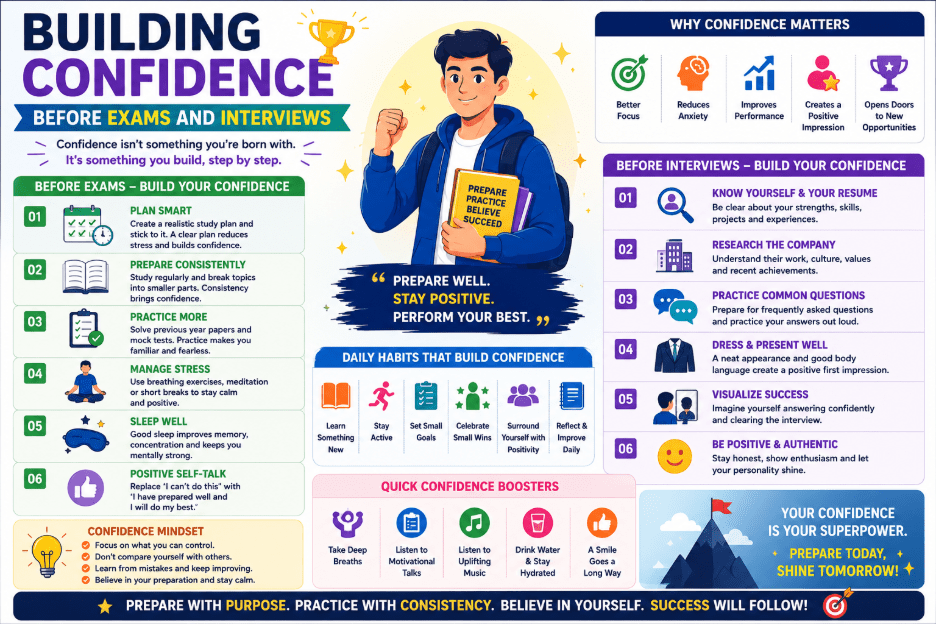
There is a particular kind of quiet that settles in the night before a big exam or a job interview. The books are closed, the Building Confidence Before Exams and Interviews
There is a particular kind of quiet that settles in the night before a big exam or a job interview. The books are closed, the outfit is picked out, and yet the mind keeps circling back to one question: am I ready?
That question, more than the syllabus or the résumé, often decides how a person performs the next day.
Confidence is not a personality trait handed out to a lucky few. It is a skill, built through preparation, repetition, and a few honest conversations with oneself.
This guide walks through what actually works when it comes to building confidence before exams and interviews, drawing on study psychology, interview coaching practice, and plain common sense. No gimmicks, no overnight fixes — just methods that hold up under pressure.
Why Confidence Matters More Than People Realise
Exam confidence and interview confidence are often treated as soft, secondary concerns — something to worry about after the “real” preparation is done. That view gets it backwards.
- A well-prepared student who freezes at a difficult question loses marks not from missing knowledge, but from nerves crowding out recall.
- A qualified candidate who mumbles through an interview from nervousness can lose out to someone less qualified but calmer.
Confidence acts as the delivery mechanism for competence. Without it, the competence a person has worked hard to build often never reaches the exam paper or the interview panel at all.
Test anxiety and interview anxiety share a common root: uncertainty about performance combined with high stakes. The good news is that both respond well to structured preparation, and neither requires years of practice to manage.
Building Confidence Before Exams
Start With a Study Schedule, Not a Study Marathon
Cramming the night before an exam feels productive but rarely is. It floods the mind with information that has nowhere to settle, and it steals the one thing that helps confidence the most: sleep.
A study schedule spread across days or weeks — with clear daily targets — does more for exam confidence than any pep talk:
- Break the syllabus into sections
- Assign realistic time blocks
- Track progress as you go
Seeing a schedule filled with completed topics gives a student tangible proof of readiness, which is far more convincing to an anxious mind than vague reassurance.
Practice Under Exam-Like Conditions
Confidence grows fastest when the brain has already rehearsed the situation it is about to face. Taking mock tests under timed conditions — in a quiet room, without notes — trains both memory and nerves. It also exposes gaps in preparation while there is still time to fix them.
Students who sit through several full-length mock papers walk into the real exam with a sense of familiarity rather than dread. The exam stops being an unknown threat and becomes something they have already survived, more than once.
Use Positive Self-Talk Deliberately
The inner voice before an exam has an outsized effect on performance. Left unchecked, it tends to drift toward worst-case thinking:
- “I am going to forget everything.”
- “I am not prepared enough.”
Replacing this with deliberate, specific self-talk works better than generic optimism. Instead of a vague “I will do well,” a more useful line is:
“I have covered every topic on the syllabus and completed four mock tests.”
Specific statements are believable in a way that generic cheerfulness is not — and a believable statement is what actually calms nerves.
Protect Sleep and Rest in the Final Days
Sleep is not a luxury to be sacrificed for extra revision hours; it is part of the revision process. Memory consolidation happens during sleep, and a tired brain performs worse on recall and reasoning tasks, regardless of how much was studied.
In the final 48 hours before an exam, protecting seven to eight hours of sleep does more for performance than an extra late night with the textbooks.
Use Simple Breathing Techniques Before Walking In
A racing heart and shallow breathing right before an exam are physical symptoms — and physical symptoms respond to physical solutions.
Try this: inhale for a count of four, hold briefly, exhale for a count of six. This slow breathing pattern signals the nervous system to calm down. It takes less than two minutes and can be done quietly at a desk, in a corridor, or in a car outside the exam hall.
Building Confidence Before Interviews
Research the Role and the Organisation Thoroughly
Uncertainty is the single biggest driver of interview nerves, and most uncertainty can be removed with research. Knowing the organisation’s recent work, understanding the role’s responsibilities, and being able to explain why the role fits one’s own experience turns an interview from an interrogation into a conversation between two informed parties.
Candidates who walk in with this groundwork tend to sound calmer simply because they are no longer guessing.
Rehearse Answers Out Loud, Not Just in the Head
There is a wide gap between knowing an answer and being able to say it smoothly under pressure. Thinking through an answer silently gives a false sense of readiness.
Saying it out loud — to a mirror, a friend, or during a mock interview — reveals awkward phrasing, forgotten details, and rambling. All of these are easy to fix before the real conversation, but hard to fix mid-interview.
The STAR method (Situation, Task, Action, Result) is a reliable structure for answering behavioural questions clearly, without losing the thread partway through.
Pay Attention to Body Language
Confidence is read visually before it is heard verbally.
| Signal | What It Communicates |
|---|---|
| Firm handshake | Composure, self-assurance |
| Steady eye contact | Engagement, honesty |
| Upright posture | Confidence, attentiveness |
| Measured pace of speech | Calm, clear thinking |
Interviewers form early impressions quickly, and body language often shapes that first impression more than the opening sentence. Practising these cues in a mock setting, even in front of a mirror, makes them feel natural rather than forced on the day.
Prepare for the Nervous Moment, Not Just the Easy Questions
Every interview has at least one question that catches a candidate off guard. Preparing only for expected questions leaves no strategy for that moment.
A simple, honest approach works best:
- Pause for a second
- Acknowledge that it’s a good question
- Think through the answer methodically
Interviewers generally respect composure under an unexpected question more than a rehearsed answer that clearly does not fit.
Reframe Nervousness as Readiness
A certain amount of nervous energy before an interview is not a warning sign — it is the body preparing to perform.
Reframing that energy as alertness rather than fear (“I am ready” instead of “I am scared”) changes how the same physical sensation is experienced. This small mental shift, used often by athletes and performers before high-pressure moments, works just as well before a job interview.
Common Mindset Shifts That Support Both Exams and Interviews
A few mindset changes apply equally to exam halls and interview rooms:
- Preparation over perfection. No one enters an exam or an interview knowing everything perfectly. The goal is solid preparation, not flawless recall.
- Growth mindset over fixed mindset. Viewing ability as something that develops with effort, rather than something fixed from birth, reduces the fear of a single bad outcome.
- Process focus over outcome focus. Concentrating on answering the current question well, rather than worrying about the final result, keeps the mind steady through the full duration of an exam or interview.
These shifts take practice, but each time they are used, they become more automatic — which is really what confidence is: a habit of thought, repeated until it feels natural.