There is a particular kind of student every teacher knows. She can recite the water cycle word for word, list the causes of a war in the correct order, and fill in a worksheet without a single mistake. Three months later, ask her to explain why any of it matters, and she goes quiet.
This is not a failure on her part. It is a failure of the method that taught her.
For generations, schools have leaned on memorization as the backbone of learning. Facts go in, tests come out, and success gets measured by how much a student can hold in short-term memory on a given morning.
Project-based learning (PBL) asks a different question. Instead of “what can you recall,” it asks “what can you do with what you know?” That shift, small as it sounds, changes everything about how students grow, think, and remember.
What Memorization Actually Teaches
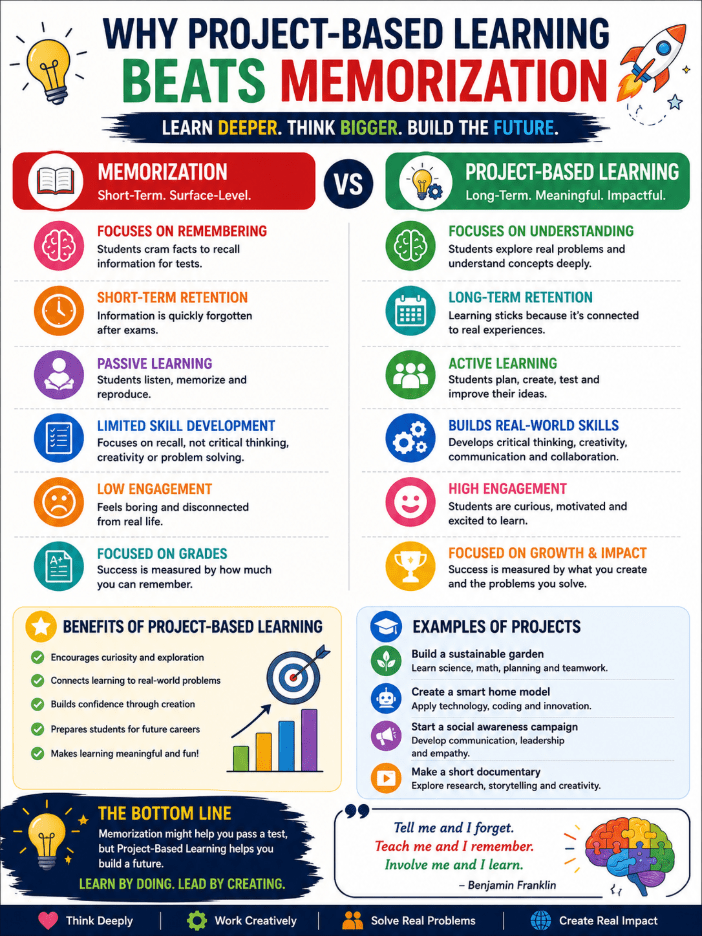
Memorization has its place. Multiplication tables, vocabulary lists, and basic chemical symbols do need to be committed to memory at some point. But when memorization becomes the main event rather than a supporting tool, it teaches students something unintended: that learning is about storage, not understanding.
The Problem With Rote Recall
Rote learning rewards short-term recall over long-term comprehension. A student who memorizes a formula for a Friday quiz can often forget it by the following Monday, because the information was never anchored to a real use.
Information sticks best when it is tied to context, emotion, or application. Facts memorized in isolation tend to fade the way a phone number fades once you stop dialing it.
There is also a quieter cost. Classrooms built around memorization often train students to see the teacher, or the textbook, as the sole source of truth. Curiosity gets replaced by compliance.
Ask most adults what they actually remember from a decade of schooling, and they will describe a science fair project, a class debate, or a group assignment gone wrong. Rarely do they mention the worksheet they aced.
What Project-Based Learning Does Differently
Project-based learning flips the sequence. Rather than delivering content and testing recall afterward, PBL hands students a real question or problem first, then lets the need for knowledge grow out of that problem.
A group tasked with designing a water filtration system for a mock village does not memorize facts about filtration in a vacuum. They research it because they need it — and that need is what makes the knowledge stay.
This approach draws on decades of educational theory, going back to thinkers such as John Dewey, Jean Piaget, and Maria Montessori, all of whom argued that learning by doing builds understanding that lecture alone cannot.
Students in project-based classrooms tend to develop:
- Stronger critical thinking — every project forces them to weigh options, defend choices, and solve problems with no answer key
- Collaboration and communication skills — as a side effect of teamwork, presentation, and revision
- Deeper content mastery — a strong climate change project still requires understanding data, geography, and chemistry; the content becomes a tool, not an end in itself
Memorization vs. Project-Based Learning: A Side-by-Side Look
| Memorization-Based Learning | Project-Based Learning | |
|---|---|---|
| Primary question | “What can you recall?” | “What can you do with what you know?” |
| Retention | Fades quickly without real-world anchor | Builds durable, long-term memory |
| Skill built | Recall under pressure | Problem-solving, adaptability, collaboration |
| Role of teacher | Sole source of truth | Guide through open-ended problems |
| Assessment | Quizzes, fill-in-the-blank tests | Rubrics, checkpoints, peer/self-assessment |
| Real-world parallel | Rare — few careers demand isolated recall | Close — mirrors how most careers actually work |
The Research Behind the Shift
Studies comparing project-based classrooms to traditional, lecture-heavy ones consistently point in the same direction:
- Students retain information longer
- Skills transfer more easily to new situations
- Engagement with the subject matter is higher
- Standardized test scores tend to hold steady or improve — quieting the old worry that hands-on learning sacrifices rigor
The biology behind it is simple. The brain forms stronger, more durable memories when new information is layered onto experience rather than delivered as an isolated fact. A student who builds a model bridge to understand load-bearing physics isn’t just learning physics — she’s learning it through touch, failure, adjustment, and success, all of which give the brain more hooks to hang the memory on than a page of notes ever could.
Preparing Students for the Real World, Not Just the Next Test
Outside the classroom, almost nobody is asked to recall isolated facts under timed pressure. Careers in medicine, engineering, business, or the arts all ask people to identify a problem, gather the right information, collaborate with others, and produce something useful.
Project-based learning mirrors that reality far more closely than a multiple-choice exam ever will.
This is why so many schools now describe PBL as a form of 21st century skills training. It builds the exact muscles employers and universities say they want:
- Problem-solving
- Adaptability
- Communication
- The ability to learn something new on the fly
A student who has spent years memorizing answers may struggle the first time she faces a question nobody has asked before. A student who has spent years building projects has already had plenty of practice doing exactly that.
Common Objections, and Why They Fall Short
“It takes too much time compared to a lecture and quiz.” True — projects take longer to plan and run. But the payoff is depth rather than speed. A single well-designed project can cover several weeks’ worth of standard content while also building skills a lecture never touches.
“Projects are harder to grade than a fill-in-the-blank test.” Fair concern, fair answer: rubrics built around specific skills, checkpoints throughout the project, and peer or self-assessment all give teachers reliable ways to measure growth without falling back on rote recall.
“Some subjects — like foundational math or early reading — still need heavy repetition.” True, and no serious advocate for PBL argues otherwise. The strongest classrooms blend both approaches — using memorization to build the basic vocabulary of a subject, and projects to put that vocabulary to work.
Bringing It Together
Memorization will always have a small, useful role in education. But when it becomes the whole strategy rather than one tool among many, it produces students who can recall information without knowing what to do with it.
Project-based learning asks more of students, and in return, it gives them more:
- Deeper understanding
- Stronger retention
- Real collaboration skills
- A habit of tackling problems head-on instead of waiting to be told the answer
The student who once recited the water cycle without understanding it deserves better than a worksheet. She deserves a project that lets her build a model watershed, test it, watch it fail, and fix it.
That is where real learning happens — and it is why project-based learning beats memorization every time it gets a fair chance.