
Every student wants better grades, more free time, and less last-minute stress. The good news: productivity is not a talent some students are born with — it’s a set of habits, practiced daily, until they become second nature.
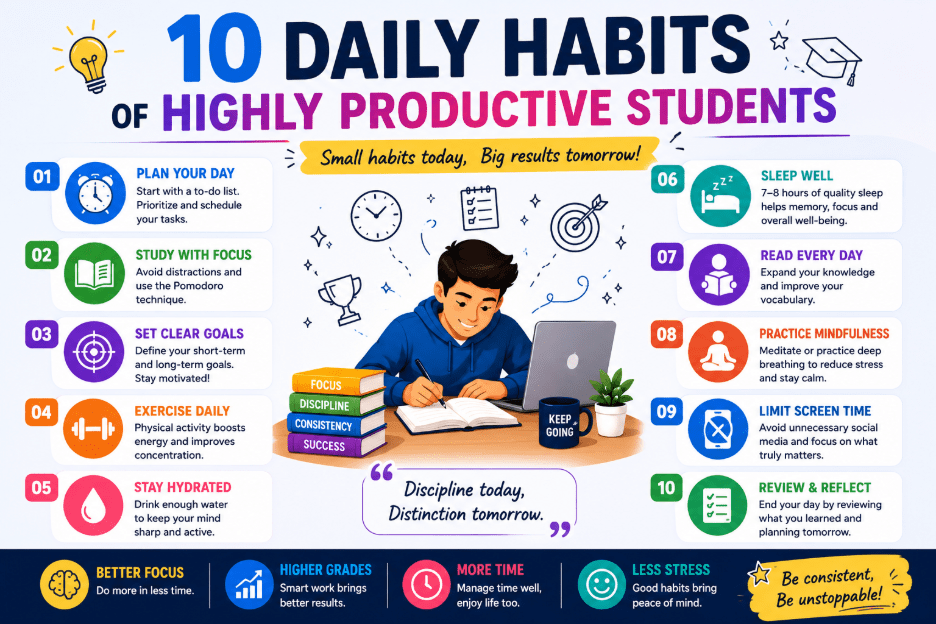
Below are ten habits that separate consistently productive students from those who are always catching up.
1. Wake Up at the Same Time Every Day
Productive students treat their mornings as the foundation of the entire day. Waking up at a fixed time, even on weekends, trains the body clock and removes the daily struggle of getting started. A steady wake-up time also makes it easier to plan study blocks well in advance.
2. Plan the Day the Night Before
Rather than deciding what to study each morning, successful students write a short plan the evening before. This can be as simple as a five-line list in a notebook or a planner app.
Planning ahead removes decision fatigue and lets a student start working the moment they sit down.
3. Use a Priority List, Not Just a To-Do List
A to-do list tells you what needs doing. A priority list tells you what needs doing first.
Productive students rank tasks by:
- Deadline — what’s due soonest
- Importance — what carries the most weight
They tackle the hardest or most urgent subject when their mind is freshest, usually in the morning.
4. Break Study Sessions Into Focused Blocks
Long, unbroken study sessions often lead to burnout and poor retention. Many high-performing students rely on focused work blocks of 25–50 minutes, followed by a short break. This method keeps concentration sharp and prevents the fatigue that comes from studying for hours without pause.
5. Remove Phone Distractions During Study Time
Notifications are one of the biggest enemies of a student’s attention span. Productive students:
- Place their phones in another room
- Switch on airplane mode
- Use a distraction blocker while studying
The goal is not willpower alone, but removing temptation before it starts.
6. Review Notes Within 24 Hours of Class
Information fades quickly unless it is reinforced. Reviewing class notes on the same day, even for ten minutes, moves material from short-term memory into long-term memory far more effectively than cramming before an exam.
7. Keep a Dedicated, Clutter-Free Study Space
A student’s environment shapes their focus. A dedicated desk, good lighting, and a clean surface send a signal to the brain that it is time to work. Studying from bed or a noisy common area, by contrast, makes deep focus far harder to reach.
8. Exercise or Move the Body Daily
Physical movement is not separate from academic performance — it supports it. A short walk, a workout, or even ten minutes of stretching increases blood flow to the brain, lifts mood, and improves memory. Productive students treat exercise as part of their study routine, not an unrelated activity.
9. Sleep at Least Seven to Eight Hours
No amount of planning can replace proper sleep. Rested students think faster, remember more, and make fewer careless mistakes. Sacrificing sleep for extra study hours usually backfires, since a tired brain absorbs information poorly.
10. Reflect on the Day Before Bed
The most consistent students spend two or three minutes each night reviewing what went well and what did not. This small habit of reflection helps identify patterns — whether it’s procrastination at a certain hour or a subject that keeps getting pushed aside — and allows the next day’s plan to improve.
Quick Reference: The 10 Habits
| S.No | Habit | Core Benefit |
|---|---|---|
| 1 | Wake up at the same time | Stabilizes body clock |
| 2 | Plan the night before | Removes decision fatigue |
| 3 | Use a priority list | Tackles hardest tasks first |
| 4 | Study in focused blocks | Sharpens concentration |
| 5 | Remove phone distractions | Eliminates temptation |
| 6 | Review notes within 24 hrs | Builds long-term memory |
| 7 | Keep a clutter-free space | Signals “time to work” |
| 8 | Exercise daily | Boosts blood flow & mood |
| 9 | Sleep 7–8 hours | Improves recall & focus |
| 10 | Reflect before bed | Reveals patterns to improve |
Final Thoughts
None of these ten habits are complicated, and none require special tools or expensive resources. What they require is repetition.
A student who plans the night before, studies in focused blocks, protects their sleep, and reflects daily will, over time, outperform a student relying on last-minute effort and willpower alone.
Productivity is built one ordinary day at a time.