
There is a moment almost everyone remembers: a rejected application, a failed exam, an interview that went nowhere, a business idea that folded within a year. Turning failures into success starts right here, in that moment when failure feels final — as though a door has been shut and locked from the other side.
But look closely at the life of anyone you’d call successful, and you’ll find the same pattern repeating: failure came first, and success followed only after the person chose to keep going.
Turning failures into success stories isn’t a slogan. It’s a discipline — one that can be learned, practiced, and applied to studies, careers, and everyday life.
Why Failure Feels Like the End (But Rarely Is)
Failure stings because it touches something personal. A poor grade or a job rejection can feel like a verdict on our worth, not just on one attempt. Psychologists describe this as the difference between a fixed mindset and a growth mindset:
| Mindset | What failure means |
|---|---|
| Fixed | “I am not good enough.” |
| Growth | “I am not good enough yet.” |
That single word — yet — changes everything. It turns a dead end into a detour.
Carol Dweck’s decades of research on mindset showed that students who viewed intelligence and ability as things that could be developed, rather than fixed traits, were far more likely to recover from setbacks and improve over time. The failure didn’t disappear. What changed was the story the student told about it.
Famous Failures That Became Success Stories
History is full of examples worth remembering when a setback feels unbearable.
- Michael Jordan was cut from his varsity basketball team as a sophomore in high school. Instead of quitting, he spent the next year working on his game before becoming one of the most decorated players in NBA history.
- J.K. Rowling was turned down by a dozen publishers before Harry Potter found a home. She’s spoken openly about how hitting a low point stripped away her fear of failure — she had already failed at the things people expected of her.
- Steve Jobs was removed from the very company he founded. He later described that experience as heavy at the time, yet a turning point that led to some of his most creative and important work.
None of these stories describe people who avoided failure. They describe people who let failure teach them something, then acted on the lesson.
The Pattern Behind Every Comeback
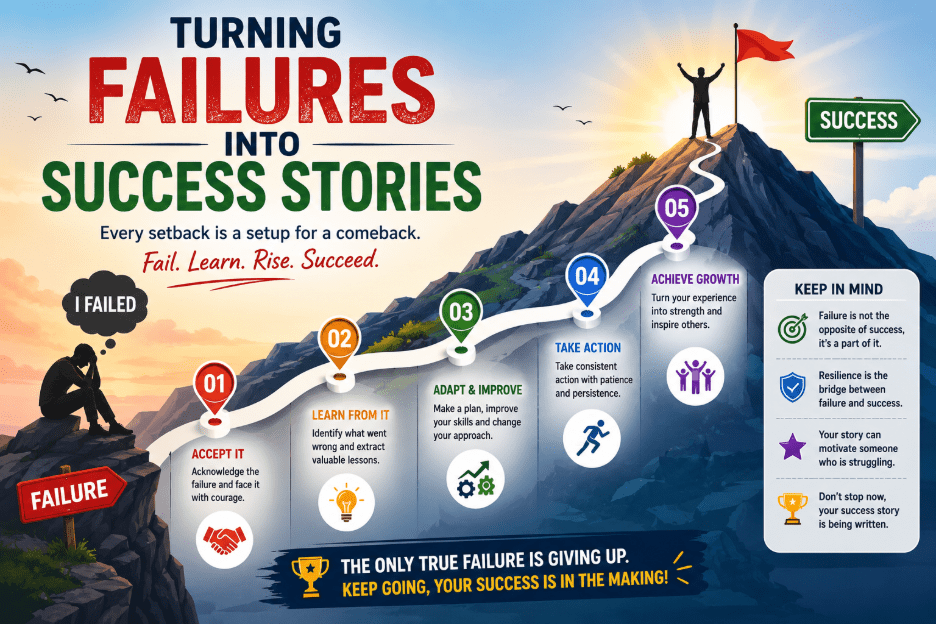
Look past the individual details, and a four-stage pattern appears:
- The setback happens. A plan doesn’t work out. This part can’t be skipped or rushed — denying that a failure occurred only delays recovery.
- A period of reflection follows. This is the stage many people avoid, because it’s uncomfortable. Yet honest reflection is where the real learning happens. What went wrong? What was within your control, and what wasn’t? Writing it down — not just thinking it — tends to make the lesson stick.
- A small, deliberate action follows. Not a grand plan — a small next step. Jordan didn’t demand a spot back on the team; he practiced. Rowling didn’t wait for perfect conditions; she kept writing and kept submitting.
- The story gets retold. Over time, the setback is folded into the larger story of how someone got where they are. What once felt like an ending becomes, in hindsight, a chapter that made the rest of the story possible.
Turning Failures Into Success: The Career Version
For students and early-career professionals, this pattern shows up constantly: a missed placement, a rejected internship application, an interview that didn’t go as planned, or a first job that didn’t work out. These moments feel large because a career still feels new and fragile.
The good news: turning failures into success at this stage responds especially well to structure and preparation — which is often what was missing the first time around.
Five practical steps that make a real difference
- Treat rejection as data, not judgment. An unsuccessful interview usually points to something specific and fixable — unclear answers, weak company research, a skills gap — rather than a lack of overall ability.
- Practice before the stakes are high. Confidence in an interview is built well before the interview itself. Mock interviews and structured feedback let you make mistakes in private, before they matter in public.
- Build real, provable skills. A resume built on hands-on project work and internship experience carries more weight than one built on claims alone.
- Look after your mental well-being along the way. Resilience is easier to sustain when a student has support for stress and anxiety, not just for exam results.
- Keep a record of progress. A simple log of skills learned and challenges overcome becomes, over months, the raw material for a genuine success story — one with evidence behind it.
How Vyasa Nexus closes this gap
This is exactly the gap that structured career support is meant to close:
- Career Readiness Bootcamps — build the fundamentals that interviews and workplaces expect.
- Mock Interviews and HR Preparation — sharpen performance so the next opportunity finds you ready, not caught off guard.
- Internship and Project Support — apply learning to live problems, turning theory into proof of skill (because failure often comes from a mismatch between classroom learning and real-world expectation).
- Career Acceleration Kits — structured, outcome-based pathways for moving faster from learning to earning.
- Student Mental Health Support Programs — because resilience isn’t only a mindset; it’s also a matter of having the right support system in place.
Writing Your Own Failure-to-Success Story
Turning failures into success is, in the end, a habit of storytelling as much as a habit of action. Every success story you admire started out looking like a failure story to the person living through it. What separated the two wasn’t luck, and it was rarely talent alone. It was the decision to reflect honestly, take one more small step, and keep going long enough for the pattern to turn.
If you’re in the middle of a setback right now — a missed placement, a difficult exam result, a job search that’s gone on longer than you expected — take it as a sign that you’re somewhere in the middle of your own story, not at its end.