
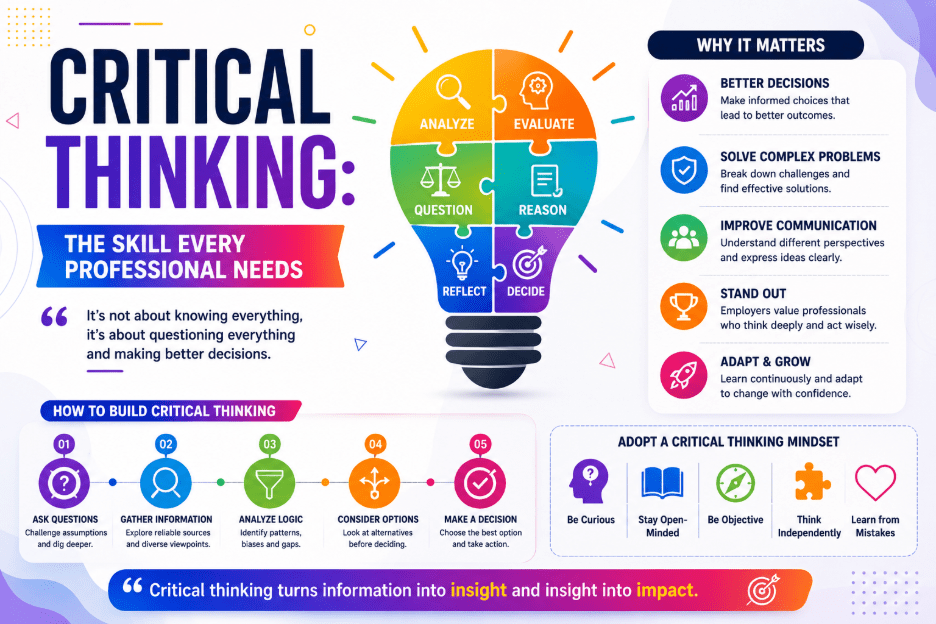
There is a quiet difference between employees who get by and employees who get ahead, and it rarely has anything to do There’s a quiet difference between employees who get by and employees who get ahead — and it rarely has anything to do with degrees or job titles. It comes down to how a person thinks.
Two workers can sit through the same meeting, read the same report, and face the same problem. Only one of them will ask the right question before acting. That habit — pausing, weighing evidence, and reasoning through a situation instead of reacting to it — is critical thinking. It has quietly become one of the most sought-after workplace skills across every industry.
What Critical Thinking Actually Means at Work
Critical thinking isn’t about being clever or having strong opinions. It’s the discipline of gathering facts, testing assumptions, and drawing conclusions based on evidence rather than habit or emotion.
In a professional setting, this shows up as four practiced abilities:
| Skill | What it looks like on the job |
|---|---|
| Observation | Noticing patterns, risks, or opportunities before they’re obvious to everyone else |
| Analysis | Breaking down data, reports, and feedback to understand what they really mean |
| Inference | Connecting separate pieces of information to reach a sound conclusion |
| Communication | Explaining that reasoning clearly enough that a team can act on it |
None of these are talents a person is simply born with. They’re practiced abilities, and like any skill, they improve with deliberate effort.
Why Employers Keep Asking For It
Search any list of in-demand workplace skills, and critical thinking sits near the top, year after year. Hiring managers consistently rate it as essential — yet just as many admit new hires struggle to apply it once they’re actually on the job. That gap between what companies want and what graduates bring with them has turned critical thinking from a nice-to-have trait into a genuine hiring filter.
The reason is simple: businesses don’t run into trouble because employees lack technical knowledge. They run into trouble because someone missed a faulty assumption, followed a flawed process without question, or made a decision under pressure without checking the facts. A workforce that thinks carefully before it acts saves money, avoids rework, and catches problems while they’re still small.
The Real Cost of Skipping This Skill
Picture a project team that accepts the first solution presented in a meeting because no one wants to slow things down. Weeks later, the plan falls apart because nobody stopped to ask an obvious question. This happens constantly, in offices of every size — and it’s rarely because people are careless. It happens because critical thinking is treated as optional rather than essential.
Employees who lack this skill tend to:
- Accept information without checking its source or accuracy
- Make decisions based on the loudest opinion in the room rather than the strongest evidence
- Struggle to adapt when circumstances change quickly
- Repeat the same mistakes because they never examine why the first one happened
Over time, this adds up to missed opportunities, strained client relationships, and a culture where problems get patched rather than solved.
How Strong Critical Thinkers Change a Workplace
Now flip the picture. A team with strong critical thinkers behaves differently under the same pressure. They ask what evidence supports a plan before committing to it. They notice when a client request doesn’t match the data in front of them. They mediate disagreements by focusing on facts instead of personalities — which quietly improves how well a team works together.
A person who has reasoned through a decision can explain it clearly — and that’s what builds trust with managers, clients, and colleagues alike.
This has a ripple effect across several areas of a career:
Better decisions under pressure. Instead of reacting to the first available option, critical thinkers weigh alternatives and consider consequences, even when time is short.
Sharper problem solving. Rather than treating symptoms, they trace an issue back to its root cause — which prevents the same problem from resurfacing.
Stronger communication. Reasoned decisions are easier to explain, and that clarity builds trust.
Greater adaptability. Markets shift, tools change, and priorities get rewritten overnight. Employees who can reassess a situation quickly are the ones who stay valuable through that change.
Fewer regrets. Research on workplace decision-making has found that people often look back on choices with doubt not because of the outcome, but because of how rushed the process felt. A thoughtful approach reduces that second-guessing and builds confidence in future decisions.
Building the Habit, Not Just the Idea
Critical thinking can’t be picked up by reading a single article or attending one workshop. It’s built the same way any professional skill is built — through repetition and honest feedback. A few practical habits make a real difference over time:
- Question the source before accepting the conclusion. Before acting on a report, a client’s claim, or even a colleague’s suggestion, ask where the information came from and whether it holds up under scrutiny.
- Slow down before deciding. Even ten minutes of deliberate thought — weighing at least one alternative — tends to produce better outcomes than an instant reaction.
- Write out the reasoning, not just the answer. Explaining why a decision makes sense, on paper or out loud, exposes gaps in logic that would otherwise stay hidden.
- Invite disagreement. Teams that treat pushback as useful rather than threatening catch mistakes earlier and reach stronger conclusions.
- Reflect after the fact. Reviewing what worked and what didn’t after a project ends turns every decision into a lesson rather than a one-time event.
Organizations that want to build this culture deliberately — rather than hoping it develops on its own — often turn to structured programs, since they put learners through real scenarios rather than abstract theory.
A Skill for Every Career Stage
Critical thinking matters just as much for someone entering the workforce as it does for a senior manager.
- A fresher walking into their first interview benefits from reasoning through a problem out loud rather than reciting a memorized answer — which is why practicing this skill ahead of mock interviews and HR prep pays off well beyond the interview itself.
- A new hire shows the same skill in how they handle a client escalation or a tight deadline — one reason structured placement and internship programs now build reasoning exercises directly into their curriculum, alongside project packs that simulate ambiguous, real-world problems a classroom rarely covers.
The good news: this is a learnable, trainable skill, not a fixed trait. With the right exposure to real problems, honest feedback, and consistent practice, any professional can sharpen it — and any organization can build a team that reasons well under pressure instead of guessing.
The Bottom Line
Technical skills get a person through the door. Critical thinking is what keeps them moving up once they’re inside. It shapes how well a person handles ambiguity, how clearly they communicate, and how much trust they earn from the people around them. In a job market where tools and technologies keep shifting, the ability to reason clearly is one of the few skills that doesn’t go out of date.