Classrooms have changed more in the last five years than in the previous fifty. Chalkboards gave way to smartboards, textbooks moved online, and now artificial intelligence is quietly rewriting how students learn, how teachers teach, and how schools measure progress.
AI-powered learning is no longer a distant idea reserved for science fiction. It’s already sitting inside the apps students use for homework, the platforms teachers use to grade essays, and the dashboards administrators use to track attendance and performance.
This shift raises a fair question: what does AI actually change about education, and what stays the same?
The honest answer: AI does not replace teachers, curiosity, or hard work. It changes the pace and shape of learning by removing friction — the friction of waiting for feedback, sitting through material you already understand, or struggling silently because no one noticed you were stuck.
What AI in Education Actually Looks Like Today
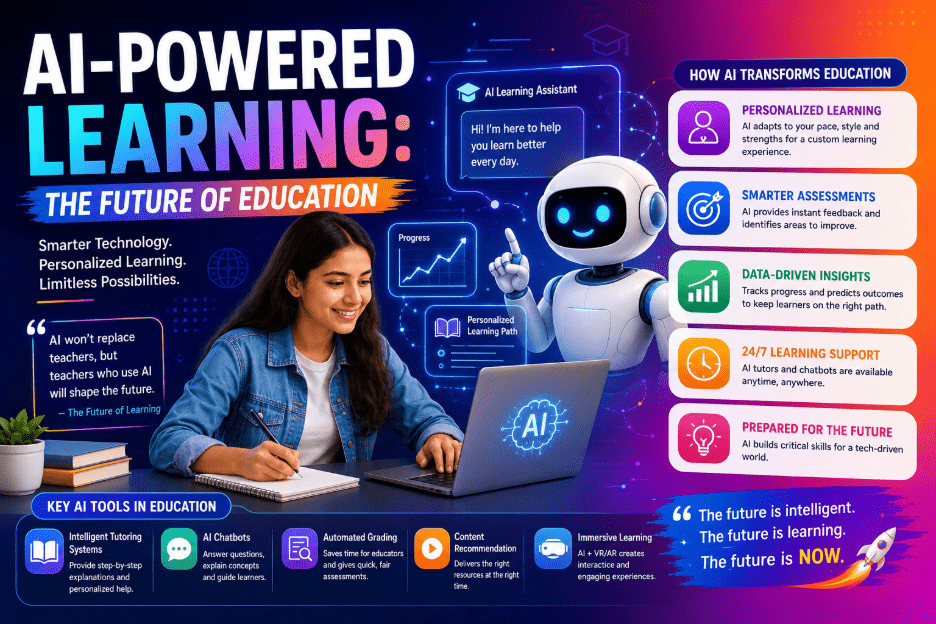
“Artificial intelligence in classrooms” sounds abstract until you break it into its everyday parts. Right now, AI in education shows up in a handful of concrete ways:
| Tool | What it does |
|---|---|
| Adaptive learning platforms | Adjust lesson difficulty based on how a student answers each question, instead of pushing everyone through the same worksheet at the same speed |
| AI tutors | Walk a student through a problem step by step, offering hints instead of answers — like a patient tutor would |
| Automated grading tools | Give students same-day feedback on essays, freeing teachers to spend more time on lesson planning and one-on-one support |
| Speech and language tools | Help students learn new languages by listening to pronunciation and correcting it in real time |
| Predictive analytics | Flag when a student’s engagement is dropping before a report card ever shows it |
None of these tools work in isolation. They work best when a teacher is still the one deciding how to use the data they produce.
Why Personalized Learning Matters
Every student learns at a different pace, and traditional classrooms were never built to accommodate that. A teacher with thirty students has thirty different starting points, thirty different attention spans, and thirty different ways of understanding a fraction or a sentence structure.
Personalized learning through AI doesn’t solve this perfectly, but it narrows the gap considerably.
When a machine learning education tool notices that a student consistently struggles with a certain type of problem, it can quietly reroute that student toward extra practice — without singling them out in front of classmates. This kind of quiet, individualized support is difficult to deliver at scale without some form of automation behind it.
The Role of the Teacher Doesn’t Shrink — It Shifts
A common worry about AI-powered educational tools is that they’ll make teachers less necessary. In practice, the opposite tends to happen.
Grading, attendance tracking, and repetitive administrative work take up a large share of a teacher’s day. When AI handles the first pass of grading or flags which students need attention, teachers get more time back for the parts of the job a machine cannot do:
- Building relationships
- Mentoring
- Reading the room in ways no algorithm can
Teachers who have adopted these tools well tend to describe them as an assistant, not a replacement — something that clears the small tasks off their desk so they can focus on the students in front of them.
Challenges Worth Taking Seriously
It would be misleading to write about the future of education without mentioning the problems that come with it.
Data privacy is a genuine concern. Schools collect enormous amounts of information about minors, and that data needs strict handling, clear consent, and real accountability if something goes wrong.
Equity is another issue. Not every school district has the budget for the latest adaptive learning software, and not every student has reliable internet access at home. If AI-powered learning tools are rolled out only in wealthier districts, the gap between well-resourced and under-resourced schools could widen rather than close.
Over-reliance is a subtler risk. If students lean on AI writing tools to produce every essay, or use AI tutors to skip the productive struggle that builds real understanding, the tools can end up working against the learning they’re meant to support.
The goal should always be building skill, not shortcutting it.
Where Things Are Headed
A few trends are becoming clear as more schools and universities test these tools:
- Hybrid classrooms — in-person teaching paired with AI-driven practice outside class hours, similar to how flipped classrooms already work
- AI-assisted curriculum design — teachers use AI to draft lesson plans, then edit them based on their own judgment of the class
- Skill-based assessment — moving away from a single test score toward ongoing, AI-tracked evidence of what a student can actually do
- Lifelong and workplace learning — AI-powered platforms help adults reskill for new careers well after they’ve left formal schooling
None of this suggests classrooms will look unrecognizable in a decade. It suggests they’ll feel a little less rigid, with more room for students to move at their own pace while still learning alongside their peers.
Frequently Asked Questions
Is AI replacing teachers in schools? No. AI handles repetitive tasks like grading and progress tracking, but decisions about a student’s wellbeing, motivation, and understanding still rest with teachers.
What is an example of AI-powered learning? An adaptive learning platform that changes the difficulty of math problems based on a student’s answers is a common example, as is an AI tutor that offers hints instead of direct answers.
Are AI tools in education safe for children’s data? Safety depends on the platform. Schools should check that any AI tool complies with student data privacy laws and only collects what’s necessary for learning outcomes.
Will AI make education more equal or less equal? It could go either way. Wider, affordable access to AI tools could close learning gaps, but uneven adoption across wealthy and under-resourced schools could just as easily widen them.
Closing Thought
AI-powered learning isn’t a single product or a single company’s promise. It’s a slow, uneven shift happening across thousands of classrooms, each adapting the technology in its own way.
The schools that get the most out of it will likely be the ones that treat AI as a tool for teachers, not a substitute for them — and that keep asking whether each new tool is actually helping a student learn, or just making the process look more efficient on paper.