
Exams end. Interviews get scheduled and rescheduled. Results come out.
And somewhere in between all of it, a student or a fresh graduate is left staring at the ceiling at two in the morning, wondering if they’ve done enough.
If that sounds familiar, you’re not alone — and there’s nothing wrong with you for feeling this way. Stress during exams and job preparation is one of the most common experiences among students today. It deserves a practical answer, not another lecture on “just relax.”
This article looks at why exam stress and job search anxiety build up in the first place, and what actually helps in the middle of it — not after it’s over.
Why Exam Stress Feels Different From Ordinary Worry
Ordinary worry passes. Exam stress and job-prep pressure tend to stick around, because they come loaded with:
- A timeline you can’t control — a test date doesn’t move because you had a bad week
- A result that feels like it defines you — a job offer doesn’t wait while you figure out your confidence
Research shared by student wellbeing groups suggests that around three out of four students feel stressed during examination periods.
That number matters. It reframes the problem: this isn’t personal failure, it’s a shared and predictable part of the process. Once you accept that, the goal shifts from “eliminate all stress” to “manage the stress well enough that it helps rather than harms.”
A small amount of pressure before an exam or interview can actually sharpen focus. It’s the excess — the kind that keeps you up at night or freezes your mind mid-question — that needs attention.
Common Triggers Behind the Stress
Before fixing anything, it helps to name what’s actually causing it. Most students and job seekers point to a similar handful of causes:
| Trigger | What it really is |
|---|---|
| Comparing your pace to classmates, friends, or LinkedIn | Social comparison, not a measure of your progress |
| Not knowing what an exam or interviewer expects | Uncertainty about the “rules” of the test |
| Piling up revision or applications until the deadline hits | A time-management problem, not a motivation problem |
| Family expectations or fear of disappointing people | External pressure layered on top of your own |
| Not knowing if your prep is even the right kind | Uncertainty about strategy, not effort |
Notice that almost none of these are really about intelligence or ability — they’re about pressure, uncertainty, and time. Which means the fix has to address those three things directly, not just your mood.
Practical Ways to Manage Exam Stress
Build a Study Plan You Can Actually Follow
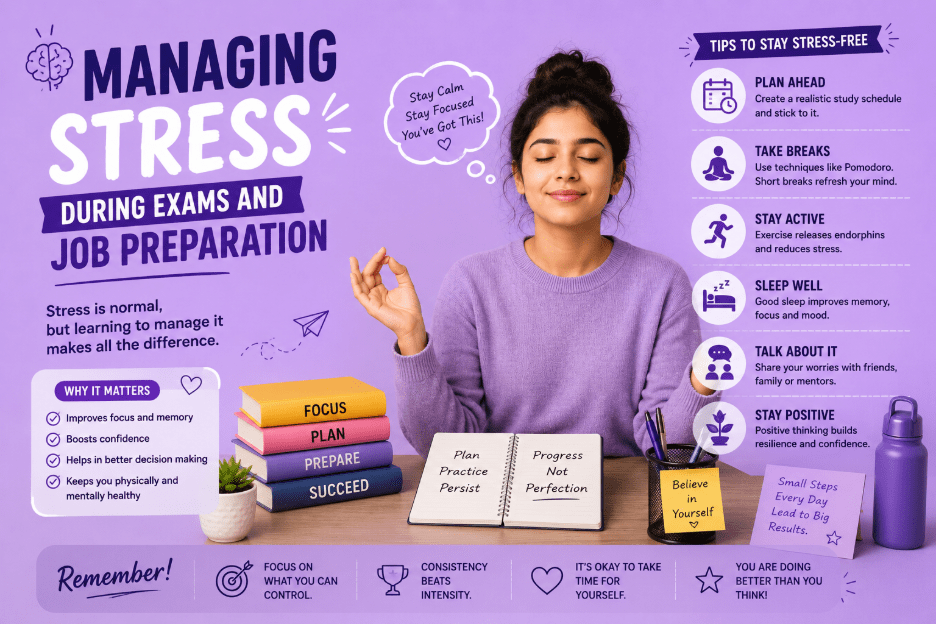
A timetable only works if it matches how you actually study. If you focus best in short bursts, don’t force three-hour blocks. Break subjects into specific goals — “finish two chapters of thermodynamics,” not a vague “study physics.” Spacing revision over several weeks, instead of cramming the final days, helps information settle into long-term memory instead of slipping away the moment the exam ends.
Use Active Recall Instead of Re-Reading
Reading your notes again and again feels productive, but rarely is. Testing yourself, explaining a topic out loud, or writing it from memory forces your brain to retrieve information the same way it will need to on exam day. Active recall and spaced repetition often do more for exam stress than any relaxation technique — because they build real confidence instead of borrowed comfort.
Take Real Breaks
A twenty-minute walk, a meal with a friend, or doing nothing for a while isn’t wasted time. Continuous studying without breaks increases fatigue and makes it harder to concentrate — exactly what an exam demands most. Schedule breaks the same way you schedule study sessions, not as an afterthought.
Protect Your Sleep
Sleep is one of the first things students give up when exams are close — and it’s usually the wrong trade. Poor sleep affects memory, concentration, and mood, all three of which you need on exam day. A tired brain doesn’t think more clearly just because it had more hours with the book open.
Talk About It
Telling a friend, parent, or teacher that you’re struggling isn’t weakness — it’s one of the more effective coping tools available. Sharing the load, even just by saying it out loud, tends to reduce how heavy it feels. If stress starts affecting your sleep, appetite, or daily functioning for more than a couple of weeks, speaking with a counsellor or mental health professional is a reasonable next step, not an extreme one.
Programs built specifically around this, such as Vyasa Nexus’s Student Mental Health Support Programs, exist precisely because exam pressure is common enough to need structured support rather than one-off advice.
Managing Stress During Job Preparation and Interviews
The stress of exams often gives way to a new kind of pressure the moment college ends: job preparation. Resume rejections, unclear job descriptions, and interview anxiety bring their own version of the same problem — uncertainty stretched over an unpredictable timeline.
Prepare With Structure, Not Just Volume
Applying to fifty jobs a day without tailoring anything rarely works — and it burns you out faster than applying to five well-matched roles with a resume and cover letter suited to each one. Research the company, understand the role, and prepare specific examples from your own experience rather than memorised generic answers.
Practice Interviews Before the Real One
Interview anxiety often comes from unfamiliarity, not lack of knowledge. Practicing with mock interviews, ideally with honest feedback, considerably reduces the fear of the unknown. Structured mock interview practice, like the Mock Interviews and HR Preparation sessions offered through Vyasa Nexus, gives candidates a realistic run-through of what a panel will actually ask — so the real interview feels familiar rather than intimidating.
Build Skills Alongside Applications
A lot of job search anxiety comes from a quiet fear that your skills aren’t current enough for the market. Closing that gap directly through structured upskilling — such as Career Readiness Bootcamps and outcome-focused Career Acceleration Kits — turns uncertainty into a concrete plan with a timeline you control.
Keep Perspective on Rejection
Not every application leads to an offer, and that’s true even for the strongest candidates.
A rejection is information about fit, timing, or competition — not a verdict on your worth.
Treating each application as one attempt among many, rather than a single make-or-break event, takes a surprising amount of pressure off the process.
Building Habits That Reduce Stress Long Term
A few habits help both students and job seekers, regardless of what stage they’re at:
- Set realistic, specific goals instead of vague, all-consuming ones
- Separate “important” from “urgent” so your energy goes to what matters first
- Keep at least one activity in your week that has nothing to do with exams or job hunting
- Ask for help earlier rather than later — academic help, mentorship, or professional support
- Track small wins — progress in preparation is often invisible until you look back
None of these remove stress completely, and that’s not really the goal. The goal is to keep stress at a level where it sharpens your focus instead of shutting it down.
Final Thoughts
Exam stress and job preparation anxiety aren’t signs that something is wrong with you. They’re signs that you care about an outcome that genuinely matters.
The difference between stress that helps and stress that harms usually comes down to structure, support, and a plan you can actually follow on your hardest days — not just your best ones.
If you’re looking for structured guidance through this stage — from academic preparation to interview readiness and mental wellbeing support — explore more resources on the Vyasa Nexus Blogs page or learn more about Vyasa Nexus and the programs designed to help students and job seekers move through this stage with less pressure and more clarity.