
Most students study the wrong way — not from lack of effort, but because the habits schools teach (rereading notes, highlighting textbooks, cramming the night before an exam) feel productive without actually working.
Decades of cognitive psychology research point to a different set of methods. The gap between what feels effective and what actually is effective turns out to be large.
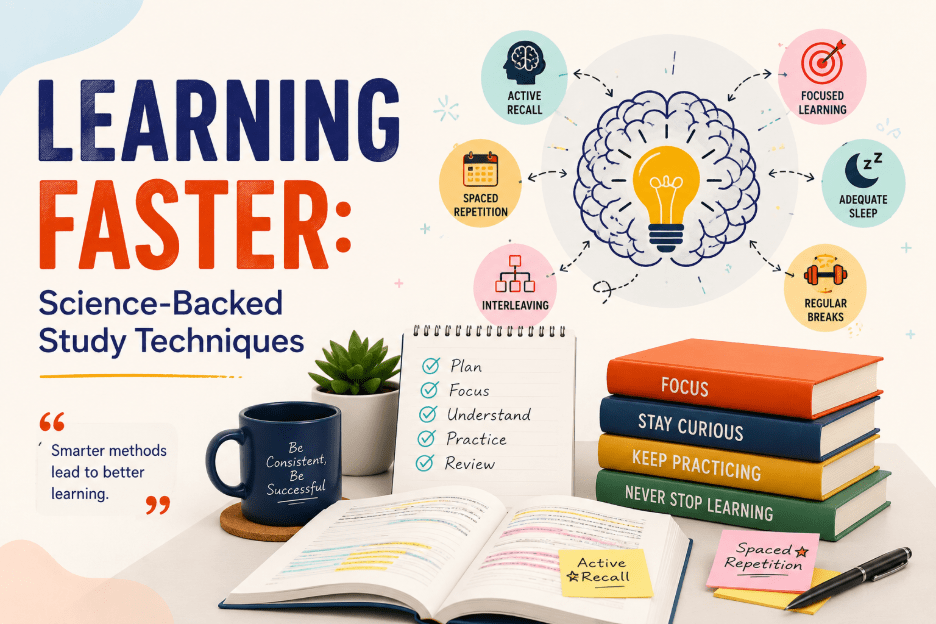
This guide covers the four study techniques with the strongest evidence behind them:
- Active recall
- Spaced repetition
- Interleaving
- The Feynman Technique
Each is backed by controlled studies, not study-hack folklore, and each can be put into practice today with nothing more than paper, a pen, or a simple app.
Why Rereading and Highlighting Don’t Work
Rereading a chapter creates a feeling of familiarity. The words look recognizable, the ideas seem to make sense, and the brain interprets that ease as knowledge.
Psychologists call this the illusion of competence — mistaking recognition for recall. Recognizing an answer on a page is far easier than producing it from memory on a blank exam sheet, which is exactly the skill a test demands.
Highlighting has the same flaw. Marking a sentence in yellow takes almost no cognitive effort, so the brain does little with the information beyond noting “this seemed important.” Neither method forces retrieval — and retrieval is where durable learning happens.
1. Active Recall: Test Yourself Before You Feel Ready
Active recall (also called retrieval practice) means closing the book and trying to produce an answer from memory rather than looking it up. Instead of rereading a definition five times, you cover it, ask yourself what it means, and force your brain to generate the answer before checking.
The research: A well-known study published in Psychological Science in the Public Interest found that students who practiced regular self-testing outperformed students who simply reread material — often by a margin close to a full letter grade. Every time you struggle to pull a fact from memory and succeed, the memory trace gets stronger. Struggle, not comfort, is doing the work.
Practical rules:
- Test yourself before you feel fully prepared — waiting until material feels easy defeats the purpose.
- Use short, specific questions rather than vague ones. (“What are the four stages of mitosis?” beats “What do I know about mitosis?”)
- Write or say the answer out loud rather than just thinking it.
- If you get a fact wrong, don’t just glance at the correct answer — write it out again from memory a second time.
2. Spaced Repetition: Fighting the Forgetting Curve
In 1885, German psychologist Hermann Ebbinghaus ran memory experiments on himself and charted how quickly newly learned information fades — the forgetting curve. Without review, we lose most new information within a day or two.
Spaced repetition directly counters that curve. Instead of studying a topic once and moving on, you review it again at increasing intervals:
| Review | Timing |
|---|---|
| First review | 1 day after learning |
| Second review | 3 days later |
| Third review | 1 week later |
| Fourth review | 2 weeks later |
| Fifth review | 1 month later |
The research: Cepeda and colleagues, drawing on more than 250 studies, found that distributed practice beat cramming for long-term retention in nearly every condition tested. Spacing interrupts forgetting right at the point where the brain has to work to retrieve the memory — the “desirable difficulty” that makes learning stick.
Spaced repetition and active recall work best together. Spacing tells you when to study; active recall tells you how. A flashcard reviewed on a spaced schedule — where you actually try to answer it rather than flipping it over immediately — combines both mechanisms in a single habit.
3. Interleaving: Mixing Subjects Instead of Blocking Them
Most students study in blocks: an hour of algebra, then geometry, then trigonometry, each kept neatly separate. Interleaving flips that structure by mixing related topics or problem types within the same session.
The logic: on a real exam, problems don’t arrive sorted by chapter. A student first has to figure out which method applies before applying it. Studying in isolated blocks never practices that harder first step.
The research: Rohrer and Taylor found that students who interleaved practice problems from different categories were substantially better at identifying the correct method on a later test than students who drilled one problem type at a time — even though the blocked group often felt more confident during practice.
Interleaving works especially well for subjects with multiple problem types (math, physics, chemistry), but also applies to language learning, history, and any subject where a learner needs to tell similar-looking concepts apart.
4. The Feynman Technique: Explain It Simply
Named after physicist Richard Feynman, this technique tests understanding by forcing you to explain a concept in plain language, as if teaching someone with no background in the subject.
Four steps:
- Write the name of the concept at the top of a blank page.
- Explain it in simple terms, as if teaching a twelve-year-old.
- Note where the explanation breaks down or gets vague — that’s exactly where understanding is incomplete.
- Go back to the source material, fill the gap, and simplify the explanation again.
This method exposes gaps that rereading never would. It’s easy to feel you understand a concept while reading a well-written paragraph about it. It’s much harder to hide a gap in understanding when you have to build the explanation yourself, in your own words, without jargon to lean on.
Putting It All Together: A Weekly Study Structure
| When | What to do |
|---|---|
| First exposure | Read or attend a lecture on new material, then immediately test yourself on the core ideas using active recall — not rereading notes. |
| Daily review | Spend 15–20 minutes reviewing flashcards or self-test questions on a spaced schedule, prioritizing the material you find hardest. |
| Weekly mixed practice | Once a week, work through a set of problems that mix several topics together rather than one at a time. |
| Before a test | Pick two or three of the hardest concepts and explain them from scratch, out loud or on paper, using the Feynman Technique to catch remaining gaps. |
None of this requires special tools — a notebook, a stack of index cards, or a simple spreadsheet is enough to run the whole system.
The underlying principle: learning happens through effortful retrieval and spaced review, not passive exposure.