Not long ago, learning meant one thing: a fixed classroom, a fixed timetable, and a teacher standing at the front of the room. That picture has changed a great deal in the last few years.
A student in a small town can now sit through a lecture delivered by a professor in another country. A working professional can finish a certification course at eleven at night, in between chores, without ever stepping onto a college campus.
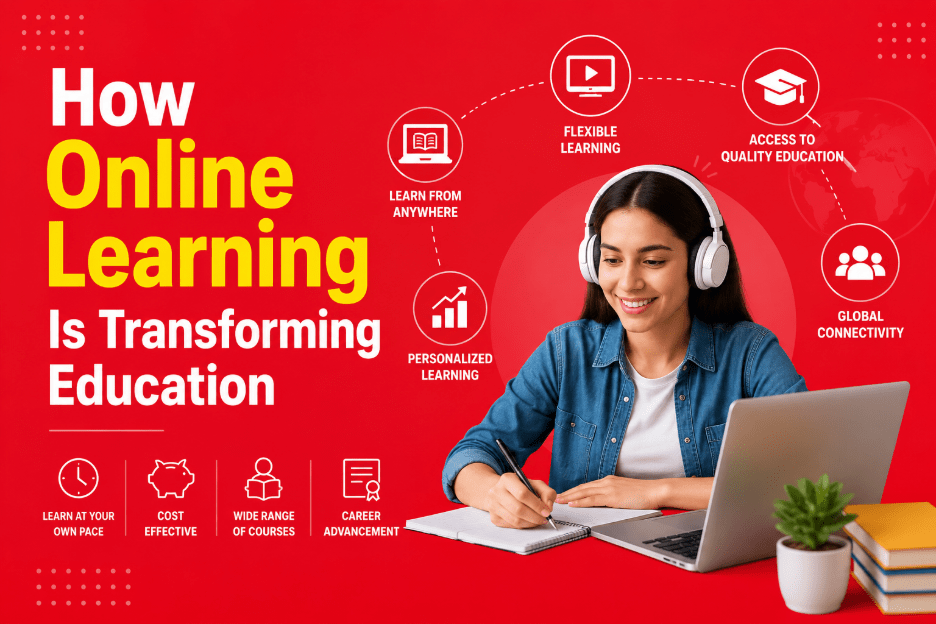
This is what people mean when they talk about online learning transforming education. It isn’t a passing trend or a temporary fix from a difficult year. It has become a permanent part of how people study, upskill, and even complete full degrees. Here’s how this shift is playing out — and why it matters for students, working professionals, and institutions alike.
From Fixed Classrooms to Flexible Learning
The most obvious change is flexibility. Traditional education runs on a rigid schedule — you attend class at a set hour, whether or not you’re ready to learn at that moment. Online learning flips this around. Courses are recorded, modules can be revisited, and a learner can move faster through a topic they already understand or slow down on one that needs more attention.
This matters more than it might seem at first. Not every student learns at the same speed, and forcing everyone into one uniform pace has always been a weak point of the traditional classroom. Online platforms let learners set their own rhythm, which eases the pressure many students feel in a conventional setup.
Access Without Geography
Perhaps the biggest shift is who gets to learn at all. A student in a remote village with a decent internet connection can now access the same lecture as a student in a metro city. Cost, distance, and infrastructure used to decide who got a good education. That barrier hasn’t disappeared, but it has weakened considerably.
Universities and training platforms have taken note. Many now offer full courses, certifications, and even degrees entirely online — often at a fraction of the cost of a traditional programme. This has opened doors for working adults, homemakers, and students from smaller towns who previously had no realistic way to access quality instruction.
Personalised and Adaptive Learning
Online learning has also brought real personalisation. Platforms today track how a learner is progressing and adjust the difficulty or sequence of lessons accordingly. If a student struggles with a concept, the system can offer more practice or explain it a different way before moving on.
This kind of adaptive learning simply wasn’t possible in a classroom of forty students working through the same textbook at the same speed. A teacher, however skilled, can’t tailor a lesson to forty individual learning curves at once. Software can — at least to a reasonable extent — and this is steadily changing how course content gets built and delivered.
The Role of AI in Modern Education
Artificial intelligence has found its way into nearly every corner of online education. AI-based tools now help:
- Generate practice questions
- Summarise long lecture notes
- Act as a study companion students can query at any hour
- Flag students who are falling behind, often before a human instructor notices
It would be wrong to say AI is replacing teachers. What it’s actually doing is taking over the repetitive, time-consuming parts of teaching — grading basic assignments, answering common doubts — freeing instructors to focus on what still needs a human touch: mentoring, motivation, and explaining ideas a machine still struggles to make clear.
Hybrid Learning Is Becoming the Norm
Very few institutions today pick one extreme or the other. Most are settling into a hybrid model, where online modules handle theory and self-paced learning, while in-person sessions are reserved for discussion, practical work, and doubt-clearing. This combination tends to work better than either format alone.
Schools, colleges, and even corporate training programmes have adopted this pattern. It gives learners the convenience of online content without losing the value of face-to-face interaction — which still matters more than most online platforms would like to admit.
Microlearning and Bite-Sized Content
Attention spans have changed, and course design has changed along with them. Long, unbroken lectures are slowly giving way to microlearning — a topic broken into short, focused segments a learner can finish in ten or fifteen minutes. This works particularly well for professionals fitting in learning between meetings or during a commute.
Short quizzes, small assignments, and quick recap videos are now standard on most online learning platforms, and they tend to keep learners more engaged than a single long recorded lecture ever could.
Skill-Based and Lifelong Learning
Online learning has also changed what people consider worth learning. A university degree is no longer treated as the finish line. Professionals now routinely take short certification courses to pick up a new skill, switch careers, or simply stay relevant in a shifting job market. This idea of lifelong learning — education that continues well past one’s twenties — has become practical largely because online courses are so accessible now.
Someone working a full-time job can learn coding, digital marketing, or data analysis without quitting that job or enrolling in a full-time programme. That kind of flexibility simply didn’t exist a couple of decades ago.
The Challenges That Remain
None of this means online learning is without problems:
- A poor internet connection can undo the benefit of even the best-designed course.
- Students who lack self-discipline sometimes struggle without the structure of a physical classroom.
- A fair number of learners still report feeling isolated, missing the sense of community that comes naturally in person.
Institutions that take online education seriously are aware of these gaps. Many are investing in better student support, discussion forums, and live sessions to bring back some of that missing interaction. The platforms that manage to combine convenience with genuine support are the ones learners stick with.
What This Means Going Forward
Education is unlikely to go back to being purely classroom-based. The more realistic future is one where online and offline learning sit side by side, each covering what it does best. Online learning will keep handling flexibility, access, and personalised pacing. Physical classrooms and in-person mentoring will keep handling the human connection, discipline, and hands-on practice that still matter a great deal.
For students and professionals planning their own learning journey, the sensible approach isn’t to pick one over the other — it’s to use both, where each makes the most sense.