
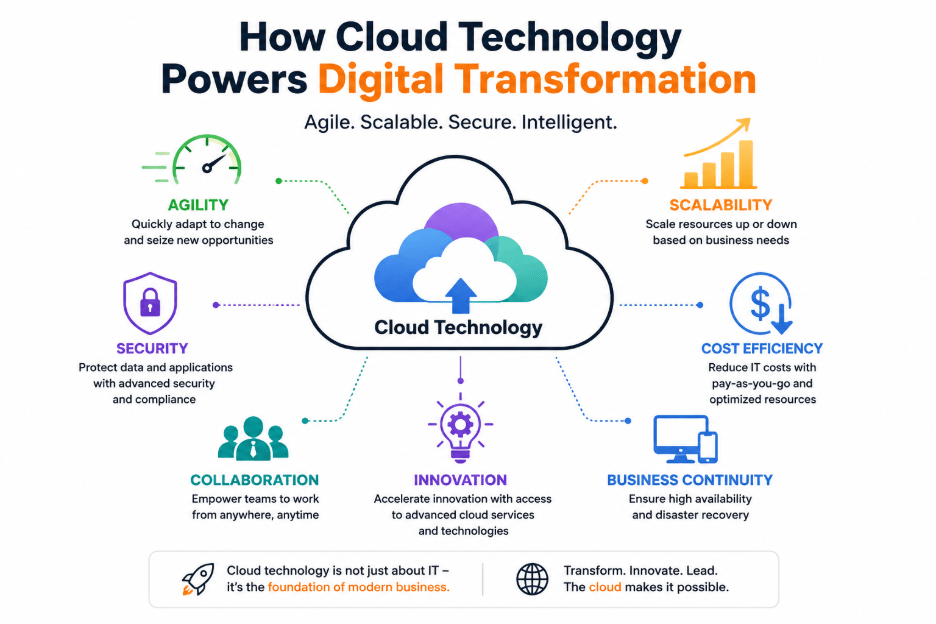
Every business reaches a point where its old way of working can’t keep up with growth. Paper-based processes get replaced by software. On-premises servers become too limiting. As that evolution continues, cloud technology often becomes the foundation for the entire business.
“Digital transformation” gets used a lot, but the idea behind it is simple: it’s the process of rethinking how a business operates and serves customers by making digital technology a core part of operations — not just an added feature.
Cloud technology is what makes this possible. Without it, most of what we now call digital transformation would be far more expensive, slower, and less practical.
This article covers how cloud computing drives business transformation, the benefits it offers, the challenges to expect, and how to build a cloud strategy that works.
What Digital Transformation Really Means
Digital transformation is about more than adopting new software. It changes how decisions get made, how teams collaborate, and how quickly an organization can respond to a shifting market.
Businesses that treat digital transformation as a one-time project often struggle to see lasting results. The ones that succeed treat it as an ongoing evolution — supported by the right technology. Increasingly, that technology is the cloud.
Why Cloud Computing Sits at the Center of It All
Cloud computing gives businesses on-demand access to computing power, storage, and software over the internet. That removes the need to maintain heavy on-premises infrastructure — and that single shift unlocks a lot of new possibilities.
1. Scalability without delays
Increasing computing capacity used to mean buying hardware, waiting for delivery, and spending weeks on installation. Cloud infrastructure changes that: businesses can scale resources up or down within minutes. Whether it’s a retailer gearing up for seasonal demand or a startup growing fast, the cloud makes expansion quick and efficient — no extra physical infrastructure required.
2. Lower costs, better resource allocation
Most cloud services run on a pay-as-you-go model, which cuts down on large upfront investments in servers and data centers. Instead of tying up capital in hardware that might sit unused, businesses can put that money toward product development, marketing, hiring, or other growth priorities.
3. Support for remote and hybrid work
Remote and hybrid work were already gaining ground before global events sped things up — and cloud technology is what made the shift possible. Employees can securely reach files, applications, and business systems from almost anywhere with an internet connection. For many organizations, that flexibility isn’t optional anymore. It’s essential for attracting talent, keeping productivity up, and maintaining business continuity.
4. Faster innovation
Cloud platforms let development teams build, test, and deploy applications far faster than traditional infrastructure allows. Instead of spending weeks or months setting up development environments, teams can spin them up on demand. That shortens the gap between an idea and a working product — a real competitive edge.
5. Smarter, data-driven decisions
Cloud platforms make it easier to collect, store, and analyze large volumes of data without running dedicated data centers. Organizations can pull insights from customer behavior, operational performance, and market trends. Paired with modern analytics and AI-powered tools, cloud platforms turn raw data into decisions businesses can actually act on.
Hybrid Cloud vs. Multi-Cloud: Choosing the Right Approach
Not every workload belongs in the same environment. Some applications run well in public cloud environments; others need to stay on private infrastructure for compliance, security, or performance reasons.
That’s why many organizations adopt a hybrid cloud strategy — combining private infrastructure with public cloud services. Others go multi-cloud, using more than one cloud provider.
Both approaches give businesses room to modernize gradually instead of moving everything at once. Customer-facing applications, for example, can move to the cloud first, while sensitive financial or regulatory systems stay on private infrastructure until the organization is ready.
Cloud Security: A Common Concern
Security is usually the first thing business leaders bring up when cloud migration comes up — and that’s fair. Handing critical infrastructure to a third-party provider requires real confidence.
In practice, major cloud providers invest heavily in cybersecurity, encryption, compliance, and threat detection — often at a level most organizations couldn’t match on their own.
That said, cloud security works on a shared responsibility model: providers secure the infrastructure itself, while businesses are responsible for managing user access, credentials, security policies, and ongoing monitoring. Even the most secure platform can’t compensate for weak internal security practices.
Common Challenges in Cloud Transformation
Most organizations run into similar obstacles during cloud adoption:
- Legacy systems that were never built for the cloud, making migration harder than expected
- Resistance to change, as employees hesitate to adopt new tools and workflows
- Unclear business objectives, making it hard to measure whether cloud initiatives are working
- Insufficient training, which keeps teams from getting full value out of new platforms
None of these are reasons to avoid cloud transformation. They just underline how much careful planning and change management matter.
Getting Started with Cloud Transformation
Organizations that adopt cloud technology successfully tend to follow a similar path:
- Identify the specific business problems the cloud can solve — rather than adopting it just because it’s popular.
- Choose the right deployment model — public, private, hybrid, or multi-cloud — based on actual business requirements.
- Involve employees early to build buy-in and reduce resistance.
- Define measurable goals, like cutting costs, speeding up deployment, or improving customer response times.
- Review and optimize regularly as business needs evolve.
Final Thoughts
Cloud technology didn’t create digital transformation, but it made it practical at a scale and speed that used to be impossible.
It lets businesses scale efficiently, innovate faster, support distributed teams, and make better decisions through data. For organizations still leaning on aging on-premises infrastructure, the cloud isn’t a future consideration anymore — it’s the foundation for staying competitive in an increasingly digital world.
Frequently Asked Questions
What is the connection between cloud computing and digital transformation? Cloud computing provides the infrastructure, flexibility, and scalability that make digital transformation possible. It lets businesses innovate, adapt quickly, and operate without the limits of traditional hardware.
Is cloud migration expensive for small businesses? Not necessarily. Most cloud services use a pay-as-you-go model, which lowers upfront costs and makes cloud adoption accessible even for smaller businesses.
What’s the difference between hybrid cloud and multi-cloud? A hybrid cloud combines private infrastructure with public cloud services. A multi-cloud strategy uses services from multiple providers, often to improve flexibility and reduce dependence on any single vendor.
How long does cloud transformation take? There’s no universal timeline. It depends on the organization’s size, the complexity of its existing systems, and how much infrastructure, data, and applications need to be migrated or modernized.