
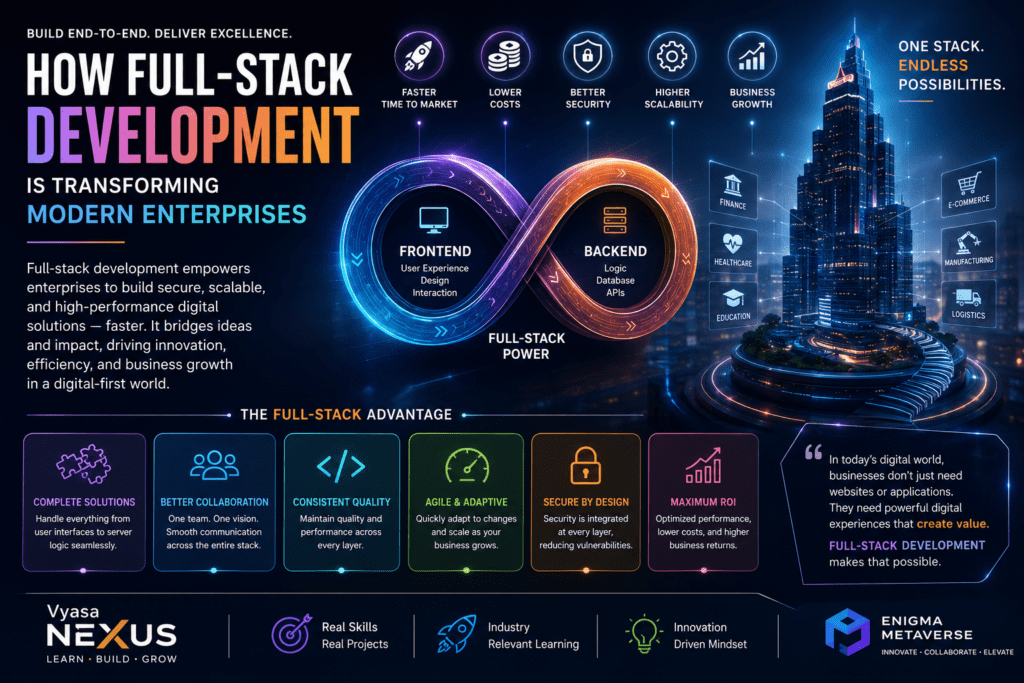
There was a time, not too long ago, when building a digital product meant assembling multiple specialized teams. One team designed the user interface, another managed the server and database, and a third ensured the two could communicate effectively. Every new feature required multiple handoffs, endless meetings, and extensive coordination. By the time the product reached customers, ownership had become blurred, and development cycles had stretched far longer than expected.
That model is rapidly disappearing, and the reason is simple: full-stack development.
Full-stack development is the practice of building both the front end—what users see and interact with—and the back end, which includes servers, databases, APIs, and business logic. Rather than treating these as isolated disciplines, full-stack development approaches them as a unified workflow. Today, it has become one of the defining characteristics of modern enterprise software development.
Why Enterprises Are Rethinking Their Development Model
For years, many large organizations viewed full-stack developers as a necessity for startups that couldn’t afford specialized teams. That perception has changed dramatically. Today, banks, healthcare providers, logistics companies, retailers, and government organizations are actively investing in full-stack engineering—not simply to reduce costs, but to improve speed, flexibility, and innovation.
1. Speed Has Become a Competitive Advantage
Digital transformation is no longer a multi-year initiative. Customers expect continuous improvements, and businesses that move slowly risk losing market share.
A retailer that spends eight months releasing a new checkout experience may find a competitor launching the same feature in half the time. Full-stack teams shorten development cycles because the same engineer—or a small cross-functional team—can work across the entire application, eliminating delays caused by waiting for multiple departments to complete separate tasks.
The result is faster prototyping, quicker testing, and shorter release cycles.
2. Modern Applications Require End-to-End Thinking
Today’s enterprise software is built around cloud-native infrastructure, microservices, and API-first architectures. These systems are deeply interconnected.
A front-end developer who doesn’t understand backend performance may unintentionally create interfaces slowed by inefficient database queries. Likewise, a backend engineer who never works with the UI may overlook how an API change disrupts the customer experience.
Full-stack developers understand both perspectives. They can evaluate how decisions made in one layer affect the entire application, leading to better architectural choices and fewer integration issues.
3. AI Has Redefined Software Development
Artificial intelligence is no longer an optional feature—it has become part of everyday enterprise software.
Organizations now integrate AI into customer support, analytics dashboards, workflow automation, document processing, and code generation. Implementing these capabilities requires connecting machine learning models and AI services on the backend with intuitive interfaces on the frontend.
Full-stack developers are often responsible for bridging that gap. Their ability to connect AI-powered services with production-ready applications makes them especially valuable, and enterprises increasingly seek professionals with both full-stack and AI integration experience.
What Full-Stack Development Looks Like Inside an Enterprise
Beyond the definition, full-stack development involves a broad range of responsibilities within enterprise IT environments.
Modern full-stack engineers typically:
- Build applications using technology stacks such as MERN (MongoDB, Express.js, React, Node.js), MEAN, or Python–Django–React, selecting technologies that align with business requirements rather than following trends.
- Design and maintain REST and GraphQL APIs that enable communication between web applications, mobile apps, internal platforms, and third-party systems.
- Work within CI/CD pipelines, using automated testing and deployment processes to deliver software safely and consistently.
- Develop applications with cloud platforms such as AWS, Microsoft Azure, and Google Cloud in mind from the beginning instead of treating cloud migration as an afterthought.
- Implement security best practices from day one, including authentication, authorization, encryption, secure APIs, and least-privilege access controls required in highly regulated industries.
None of this eliminates the need for specialists. Large enterprises still depend on software architects, security engineers, database administrators, and infrastructure experts.
What full-stack development changes is the amount of coordination required to deliver a feature. Teams can move from concept to production much faster because fewer people are needed for day-to-day implementation.
The Business Value Beyond Technology
Technology decisions in large organizations are driven by business outcomes as much as engineering excellence. Full-stack development delivers measurable advantages across several areas.
Lower Coordination Costs
Every handoff between teams creates opportunities for miscommunication, delays, and duplicated effort.
When fewer teams are involved in building a feature, projects move more smoothly and accountability becomes much clearer.
Faster Time to Market
Industries such as fintech, healthcare, and e-commerce compete on the speed of innovation.
Full-stack teams that own features from design through deployment can release updates more quickly without waiting for multiple departments to synchronize schedules.
Better Cloud Cost Management
Developers who understand both application architecture and infrastructure are more likely to build efficient systems.
They recognize how inefficient frontend requests increase backend processing, database usage, and cloud infrastructure costs, allowing them to optimize applications holistically.
More Flexible Hiring Strategies
Finding highly specialized engineers is increasingly difficult and expensive.
Organizations that build teams around adaptable full-stack developers, supported by a smaller number of deep specialists, often gain greater staffing flexibility while maintaining technical excellence.
Stronger Digital Transformation
Whether modernizing legacy software, launching customer portals, or automating internal workflows, enterprises benefit from teams capable of delivering complete solutions without excessive organizational dependencies.
Industries Leading the Shift
Several industries have embraced full-stack development more aggressively because their software ecosystems evolve rapidly and require close integration.
Fintech
Financial technology companies rely on full-stack teams to build secure, high-performance platforms that integrate payment gateways, fraud detection, compliance systems, and real-time transaction processing.
Healthcare
Healthcare organizations use full-stack engineering to connect patient records, appointment scheduling, telemedicine platforms, and clinical systems while maintaining strict privacy and security standards.
E-Commerce
Retail businesses depend on full-stack developers to keep customer experiences, inventory management, payment processing, recommendation engines, and logistics systems working together under heavy traffic.
EdTech
Education technology companies increasingly build unified platforms that combine learning management, assessments, collaboration tools, analytics, and career services into seamless user experiences.
What This Means for the Next Generation of Developers
For students, career changers, and early-career professionals, enterprise hiring trends offer a clear message.
Companies are no longer looking only for developers who can build attractive user interfaces. They increasingly expect engineers to understand databases, APIs, cloud platforms, DevOps fundamentals, security principles, and AI-assisted development.
Structured, project-based learning helps bridge that gap far more effectively than collecting certificates alone.
Hands-on internships, real-world projects, and mentorship from experienced software engineers provide the practical experience employers consistently value.
Programs such as the Career Readiness Bootcamps at Vyasa Nexus are designed around this philosophy by combining full-stack education with practical industry exposure.
Learners seeking deeper experience can also benefit from Industry Project Packs, which simulate end-to-end software ownership similar to enterprise environments. The Placement & Internship Access Pass helps connect technical training with internship opportunities, while AI Productivity Packs prepare developers to integrate AI tools into their everyday workflows.
A Balanced Perspective
Full-stack development is not without limitations.
Generalists cannot replace every specialist. Complex areas such as distributed systems, database optimization, cybersecurity, and large-scale architecture still require deep expertise developed over many years.
Organizations that attempt to eliminate specialization entirely often struggle when applications need to scale under demanding production workloads.
The most successful enterprises combine versatile full-stack developers with experienced specialists in architecture, security, infrastructure, and data engineering.
This balance allows teams to move quickly without sacrificing technical depth.
Looking Ahead
Enterprise software will continue evolving around cloud-native architecture, API-first design, AI-assisted development, and increasingly intelligent automation.
The developers who thrive in this environment will be those who understand how every layer of an application works together rather than focusing exclusively on a single specialization.
Businesses investing in full-stack talent—and educational institutions preparing future developers—are responding to the same reality: modern software is built collaboratively across the entire technology stack, not within isolated silos.
Full-stack development is no longer a startup trend or a temporary hiring preference. It has become a practical response to one of the biggest challenges facing modern enterprises: delivering secure, scalable, AI-enabled software at the speed today’s markets demand.
Organizations that treat full-stack development as a strategic capability—not simply another job title—will be best positioned to build the next generation of digital products.