
Introduction
In today’s digital world, applications rarely work in isolation. Whether you’re booking a ride, making an online payment, or logging in with your social media account, APIs (Application Programming Interfaces) are working behind the scenes to connect different systems.
This blog will break down APIs in a simple, beginner-friendly way and help you understand why they are essential in modern software development.
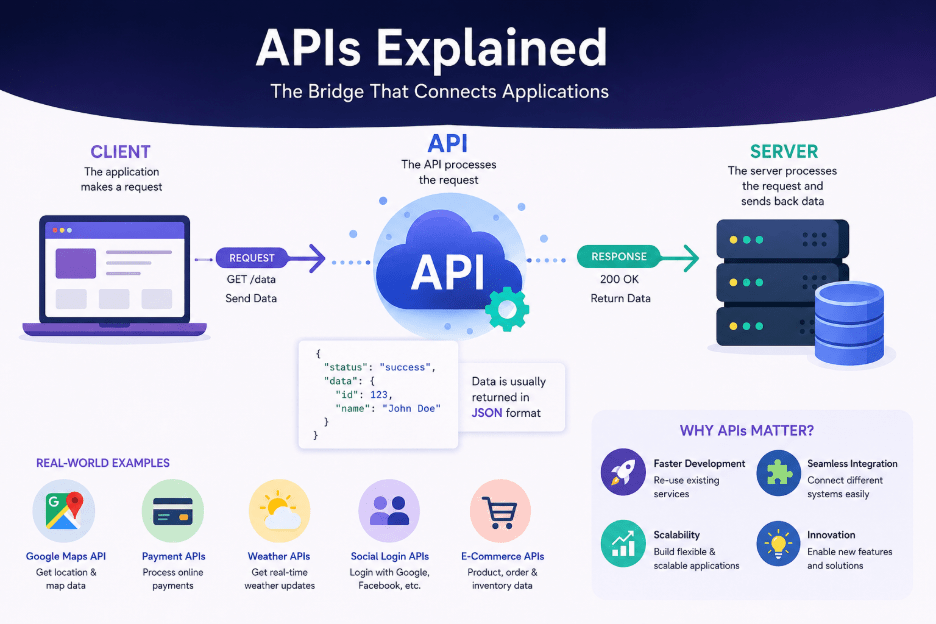
What is an API?
An API (Application Programming Interface) is a set of rules that allows one software application to communicate with another.
Think of an API like a waiter in a restaurant:
- You (the client) place an order
- The waiter (API) takes your request to the kitchen (server)
- The kitchen prepares your food
- The waiter brings back the response
👉 In simple terms:
API = Bridge between two systems
How Do APIs Work?
APIs follow a request-response model:
- Client Request
An application sends a request to the API (e.g., get user data)
- API Processing
The API validates and forwards the request to the server
- Server Response
The server processes the request and sends data back
- API Response
The API returns the result to the client (usually in JSON format)
Types of APIs
1. REST APIs
- Most commonly used
- Uses HTTP methods like GET, POST, PUT, DELETE
- Lightweight and easy to use
2. SOAP APIs
- More secure and structured
- Uses XML format
- Common in enterprise systems
3. GraphQL APIs
- Allows clients to request only the data they need
- Reduces over-fetching
4. Web APIs
- Accessible over the internet
- Used in web and mobile apps
Real-World Examples of APIs
- Google Maps API → Used for location and navigation
- Payment APIs → Used by apps like online shopping for transactions
- Weather APIs → Fetch real-time weather data
- Login APIs → Sign in using Google or Facebook
Why Are APIs Important?
- Integration → Connect different systems easily
- Efficiency → Save development time
- Scalability → Build modular applications
- Innovation → Enable new features quickly
API Security Basics
Security is critical when working with APIs:
- Authentication → Verify user identity (API keys, OAuth)
- Authorization → Control access levels
- Encryption → Protect data using HTTPS
- Rate Limiting → Prevent misuse
Advantages of APIs
- Faster development
- Reusability of services
- Easy third-party integration
- Improved user experience
Challenges of APIs
- Security risks
- Version management
- Dependency on external services
- Performance issues if not optimized
Conclusion
APIs are the foundation of modern digital ecosystems. From mobile apps to enterprise platforms, they enable seamless communication between systems and power the connected world we live in.
If you’re a developer, understanding APIs is not optional—it’s essential.
🚀 Quick Summary
- API = Communication bridge between applications
- Works on request-response model
- Types: REST, SOAP, GraphQL
- Used everywhere: payments, maps, login, etc.
- Key focus: security, performance, scalability