
Critical thinking is more than just a buzzword—it’s a vital life skill that helps you analyze information, solve problems, and make better decisions in both personal and professional settings. In a world flooded with information, mastering critical thinking can set you apart.
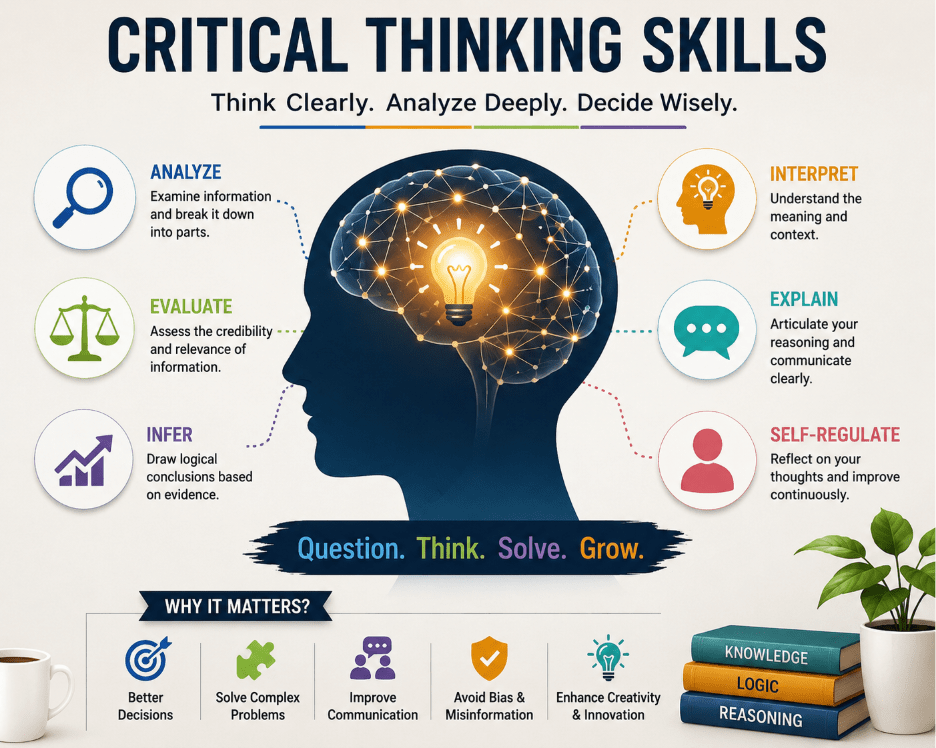
What Are Critical Thinking Skills?
Critical thinking is the ability to think clearly and rationally, understanding the logical connection between ideas. It involves evaluating facts, questioning assumptions, and making reasoned judgments rather than relying on emotions or biases.
Why Are Critical Thinking Skills Important?
Strong critical thinking skills help you:
- Make informed decisions
- Solve complex problems effectively
- Improve communication and argumentation
- Avoid misinformation and bias
- Enhance creativity and innovation
Whether you’re a student, professional, or entrepreneur, these skills are essential for success.
Key Components of Critical Thinking
1. Analysis
Breaking down complex information into smaller parts to understand it better.
2. Evaluation
Assessing the credibility and relevance of information sources.
3. Inference
Drawing logical conclusions based on available evidence.
4. Interpretation
Understanding and explaining the meaning of information.
5. Explanation
Clearly articulating your reasoning and conclusions.
6. Self-Regulation
Reflecting on your own beliefs, values, and thought processes.
🛠️ How to Develop Critical Thinking Skills
✔️ Ask Questions
Don’t accept information at face value. Ask “why,” “how,” and “what if.”
✔️ Analyze Information
Look for patterns, connections, and inconsistencies.
✔️ Consider Different Perspectives
Explore alternative viewpoints before forming conclusions.
✔️ Practice Problem-Solving
Engage in puzzles, case studies, or real-life scenarios.
✔️ Reflect on Your Thinking
Evaluate your own thought process and identify biases.
Real-Life Applications
Critical thinking is used in everyday situations such as:
- Making financial decisions
- Evaluating job offers
- Solving workplace challenges
- Understanding news and media
- Planning personal goals
Common Barriers to Critical Thinking
- Emotional reasoning
- Confirmation bias
- Lack of information
- Overconfidence
- Groupthink
Recognizing these barriers is the first step toward overcoming them.
Tips to Strengthen Critical Thinking Daily
- Read widely from diverse sources
- Engage in discussions and debates
- Write and reflect regularly
- Stay curious and open-minded
- Challenge your assumptions
Conclusion
Critical thinking is not an innate talent—it’s a skill that can be developed with practice and awareness. By cultivating these skills, you empower yourself to navigate challenges, make better decisions, and achieve greater success in all areas of li