
Problem-solving is one of the most valuable skills you can develop—whether you’re a student, a professional, or simply navigating everyday life. The ability to analyze situations, think critically, and come up with effective solutions can set you apart in any field.
In this blog, we’ll explore powerful problem-solving techniques that can help you tackle challenges with clarity and confidence.
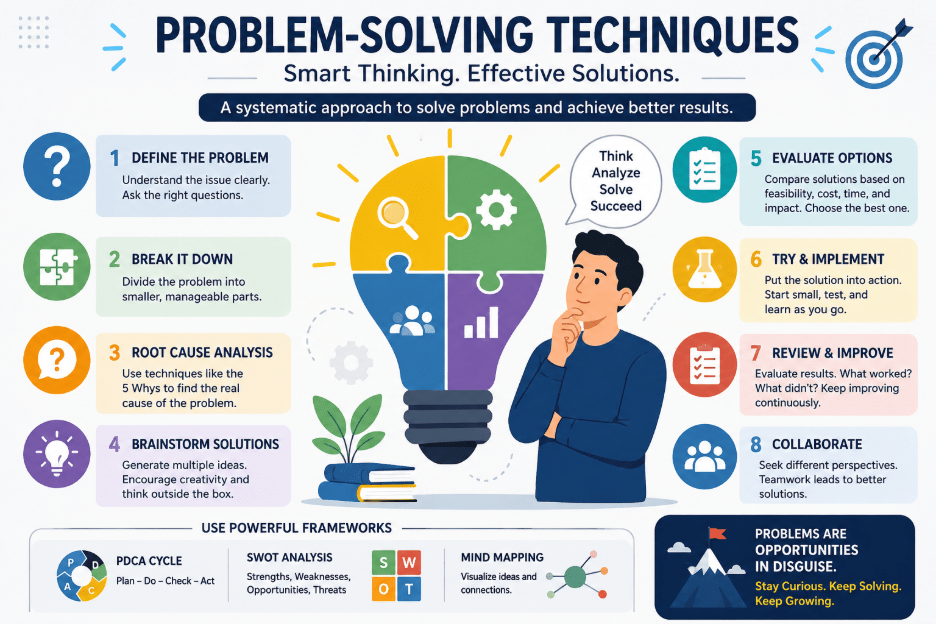
What is Problem-Solving?
Problem-solving is the process of identifying an issue, understanding its root cause, and finding the best possible solution. It’s not just about fixing things—it’s about thinking strategically and making informed decisions.
Why Problem-Solving Skills Matter
- Improves decision-making
- Boosts productivity
- Enhances creativity
- Builds confidence
- Helps in career growth
Top Problem-Solving Techniques
1. Define the Problem Clearly
Before jumping to solutions, understand the problem thoroughly.
Ask yourself:
- What exactly is the issue?
- Why is it happening?
- Who is affected?
A well-defined problem is half solved.
2. Break It Down (Divide & Conquer)
Large problems can feel overwhelming. Break them into smaller, manageable parts.
Example:
Instead of solving a “project delay,” break it into:
- Resource issues
- Time management
- Communication gaps
3. Root Cause Analysis (5 Whys Technique)
Ask “Why?” multiple times to dig deeper into the real cause.
Example:
- Problem: Project missed deadline
- Why? Tasks were delayed
- Why? Team lacked clarity
- Why? Requirements were unclear
Now you know the real issue!
4. Brainstorm Solutions
Generate multiple ideas without judging them initially.
Tips:
- Think freely
- Encourage creativity
- Write down all ideas
5. Evaluate and Choose the Best Solution
Not every idea will work. Compare options based on:
- Feasibility
- Cost
- Time
- Impact
6. Use the Trial-and-Error Method
Sometimes, the best way to learn is by trying.
- Test small solutions
- Learn from failures
- Improve continuously
7. Apply Critical Thinking
Analyze the situation logically and avoid assumptions.
Ask:
- Is this information reliable?
- What are the risks?
- Are there alternative approaches?
8. Collaborate with Others
Two (or more) minds are often better than one.
- Seek feedback
- Discuss ideas
- Learn from others’ experiences
Popular Problem-Solving Frameworks
PDCA Cycle (Plan–Do–Check–Act)
- Plan: Identify the problem
- Do: Implement solution
- Check: Evaluate results
- Act: Improve and standardize
SWOT Analysis
- Strengths
- Weaknesses
- Opportunities
- Threats
Mind Mapping
Visualize ideas and connections to understand problems better.
Real-Life Example
Situation: Low productivity at work
Approach:
- Identify issue → Missed deadlines
- Root cause → Poor time management
- Solution → Use task tracking tools
- Result → Improved efficiency
Tips to Improve Your Problem-Solving Skills
- Stay calm and patient
- Practice regularly
- Learn from mistakes
- Keep an open mind
- Improve observation skills
Conclusion
Problem-solving is not just a skill—it’s a mindset. By using structured techniques and staying curious, you can tackle even the most complex challenges with ease.
Start applying these techniques today, and you’ll notice a significant improvement in how you think, decide, and succeed.