
Common Coding Mistakes (and How to Avoid Them)
Coding is a journey full of learning, debugging, and growth. Whether you’re a beginner or an experienced developer, mistakes are part of the process. The key is recognizing them early and knowing how to fix—or better yet, prevent—them.
Let’s explore some of the most common coding mistakes and how you can avoid them.
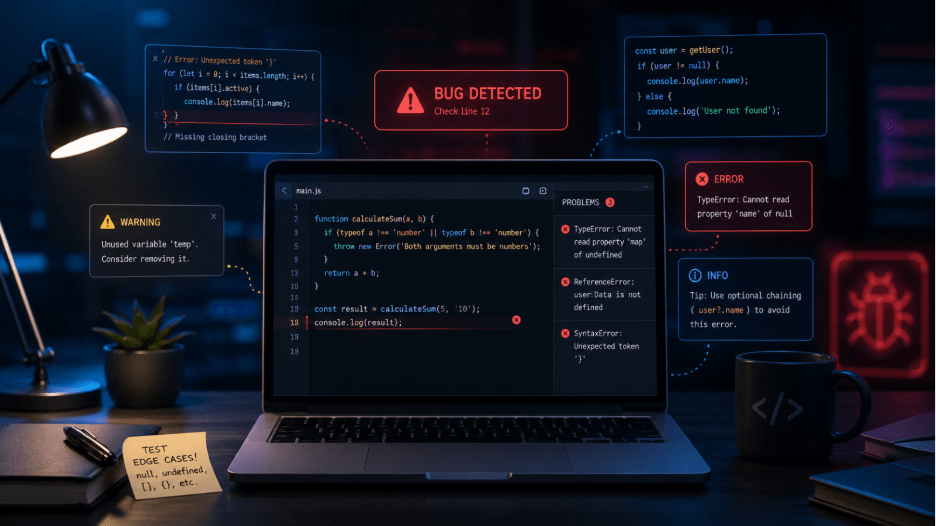
1. Not Understanding the Problem Clearly
One of the biggest mistakes is jumping straight into coding without fully understanding the problem.
Why it’s a problem:
- Leads to incorrect logic
- Wastes time rewriting code
How to avoid:
- Break down the problem
- Write pseudocode
- Ask questions before starting
2. Ignoring Code Readability
Writing code that works is great—but writing code that others (and your future self) can understand is even better.
Common issues:
- Poor variable names (x, temp, abc)
- No indentation
- Long, complex functions
Best practices:
- Use meaningful variable names
- Follow consistent formatting
- Keep functions small and focused
3. Not Handling Errors Properly
Many developers ignore edge cases and error handling.
Example:
- Not checking for null values
- Ignoring user input validation
Fix:
- Use try-catch blocks
- Validate inputs
- Think about “what could go wrong?”
4. Copy-Pasting Code Without Understanding
It’s tempting to grab code from the internet—but blindly using it can cause bigger issues.
Risks:
- Security vulnerabilities
- Bugs you don’t understand
- Compatibility issues
Solution:
- Always read and understand code before using it
- Test it thoroughly
5. Not Testing Code Enough
“If it works once, it’s done” — this mindset leads to bugs later.
Better approach:
- Test different scenarios
- Use unit testing
- Try edge cases
6. Overcomplicating Solutions
Sometimes developers try to be “too smart” and create complex solutions for simple problems.
Remember:
Simple code is better than clever code.
Tip:
- Choose clarity over complexity
- Refactor when needed
7. Ignoring Version Control
Not using version control (like Git) is a huge mistake.
Problems:
- Losing code
- Difficulty tracking changes
- No backup
Fix:
- Use version control from day one
- Commit regularly
- Write meaningful commit messages
8. Not Learning from Mistakes
Mistakes are valuable—but only if you learn from them.
What to do:
- Review your bugs
- Understand why they happened
- Avoid repeating them
Final Thoughts
Mistakes are not failures—they are stepping stones to becoming a better developer. The more you code, the more you’ll recognize patterns and avoid common pitfalls.
👉 Focus on writing clean, understandable, and tested code.
👉 Keep learning and improving every day.
Quick Recap
- Understand the problem first
- Write clean and readable code
- Handle errors properly
- Avoid blind copy-pasting
- Test thoroughly
- Keep solutions simple
- Use version control
- Learn from mistakes