
Soft Skills vs Hard Skills Explained: Key Differences, Importance & Career Impact
In today’s competitive job market, success is no longer defined by technical knowledge alone. Employers now look for a balanced mix of soft skills and hard skills to evaluate a candidate’s overall capability. Understanding the difference between the two—and how to develop them—can significantly boost your career growth.
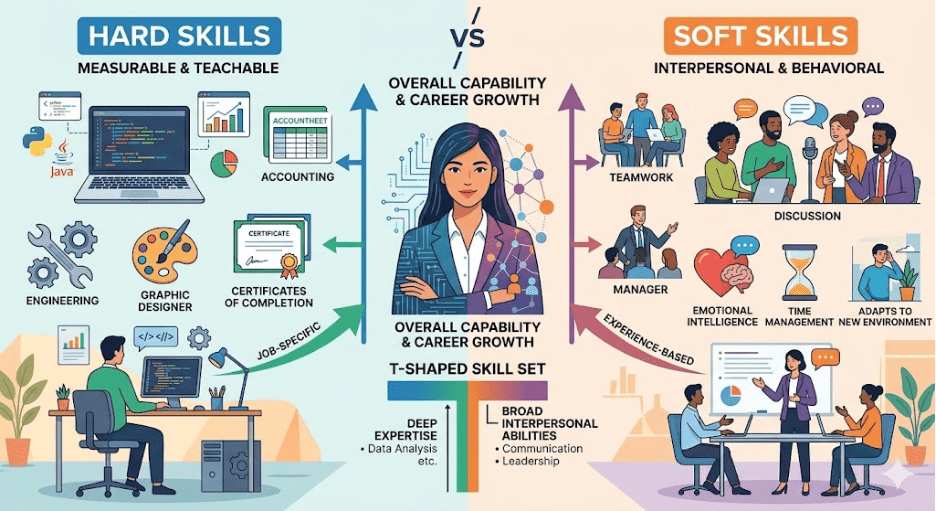
What Are Hard Skills?
Hard skills are measurable, teachable abilities that are usually gained through education, training, or hands-on experience. These skills are job-specific and can be tested or certified.
Examples of Hard Skills:
- Programming (Python, Java, SQL)
- Data analysis and statistics
- Accounting and financial reporting
- Graphic design tools (Photoshop, Illustrator)
- Foreign languages
- Machine operation or technical engineering
Key Characteristics:
- Easy to measure and evaluate
- Learned through formal education or training
- Often required in job descriptions
- Verified through certifications or tests
👉 Example: A software developer must know coding languages like Java or Python to perform their role effectively.
What Are Soft Skills?
Soft skills are interpersonal and behavioral abilities that define how you interact with others and handle situations. Unlike hard skills, they are not technical but are equally important in the workplace.
Examples of Soft Skills:
- Communication skills
- Teamwork and collaboration
- Problem-solving ability
- Leadership and decision-making
- Emotional intelligence
- Time management
- Adaptability
Key Characteristics:
- Harder to measure but highly observable
- Developed through experience and practice
- Applicable across all industries
- Essential for teamwork and leadership
👉 Example: A manager who can communicate clearly and motivate a team demonstrates strong soft skills.
Soft Skills vs Hard Skills: Key Differences
| Feature | Hard Skills | Soft Skills |
| Nature | Technical & job-specific | Behavioral & interpersonal |
| Measurement | Easy to test or certify | Difficult to quantify |
| Learning Method | Formal education, training | Experience, observation |
| Examples | Coding, accounting, design | Communication, teamwork, leadership |
| Career Role | Helps perform tasks | Helps manage people & situations |
Why Both Skills Matter for Career Growth
Employers today prefer candidates who can balance technical expertise with strong interpersonal abilities. Having only one type of skill may limit long-term success.
1. Hard Skills Get You Hired
Recruiters first look for hard skills to ensure you can perform the job.
2. Soft Skills Help You Grow
Once hired, soft skills determine how effectively you collaborate, lead, and grow within the organization.
3. Leadership Requires Both
Great leaders combine technical understanding with emotional intelligence and communication skills.
Real-World Example
A data analyst may have strong hard skills in SQL and Excel. However, without soft skills like communication and storytelling, they may struggle to explain insights to stakeholders.
Similarly, a project manager needs both technical knowledge and leadership skills to successfully deliver projects.
How to Improve Hard Skills
- Enroll in online courses or certifications
- Practice through real-world projects
- Attend workshops and technical training
- Stay updated with industry tools and trends
How to Improve Soft Skills
- Join group discussions or public speaking clubs
- Work on team-based projects
- Practice active listening
- Take feedback seriously and improve
- Observe effective leaders and learn from them
Which Is More Important?
Neither soft skills nor hard skills are more important on their own. The most successful professionals develop a combination of both, often referred to as a T-shaped skill set:
- Deep expertise in one area (hard skill)
- Broad interpersonal abilities (soft skills)
Conclusion
Understanding soft skills vs hard skills is essential for career development in any field. While hard skills help you secure a job, soft skills ensure long-term success and leadership growth.
To stay competitive in today’s evolving job market, focus on building a strong balance between both skill sets.