
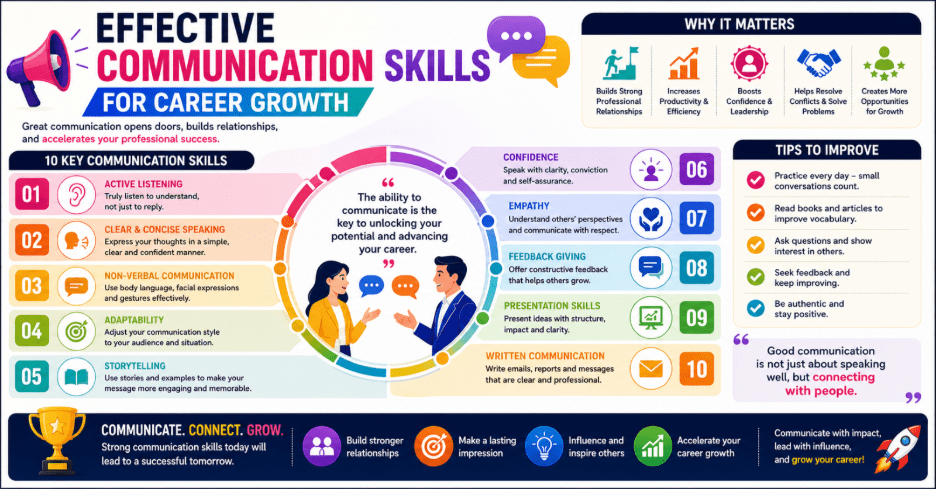
Most people spend years polishing their technical skills and barely an hour thinking about how they speak, write, or listen at work. That is a mistake. Studies from employers across industries keep showing the same pattern: candidates get hired for their qualifications, but they get promoted for how well they communicate. If you have ever watched a less experienced colleague move up faster than you, the difference often comes down to communication skills for career growth, not raw talent.
This article walks through why communication matters so much at work, the specific skills worth building, and practical steps you can start using this week.
Why Communication Skills Decide Career Success
Every job, no matter the title, runs on communication. Engineers explain designs to non-technical stakeholders. Managers give feedback that either motivates or discourages a team. Salespeople persuade a room full of skeptical buyers. None of this works without clear, confident communication.
Employers notice this too. Surveys of hiring managers repeatedly find that communication skills rank above technical ability when it comes to deciding who gets promoted. It makes sense once you think about it. A brilliant idea that nobody understands is worthless to a business. A good idea explained clearly, on the other hand, gets funded, staffed, and shipped.
Communication in the workplace also shapes how much people trust you. When you explain expectations clearly, deadlines get met and misunderstandings shrink. When you listen well, people feel respected and are more willing to share information, feedback, and opportunities with you. Over years, this builds the kind of professional reputation that leads to raises, references, and leadership roles.
The Four Types of Workplace Communication
Before getting into specific skills, it helps to separate communication into its basic forms. Most professional communication skills fall into one of these categories:
Verbal communication happens through spoken words, whether face to face, over the phone, or on a video call. This is the channel to use when you need immediate feedback, when a topic is sensitive, or when tone of voice carries meaning that text cannot.
Written communication covers emails, reports, project documentation, and messages sent through chat tools. Clear writing matters just as much as clear speaking, sometimes more, since a poorly worded email can be forwarded, misread, and misquoted long after you have forgotten you sent it.
Nonverbal communication includes body language, posture, eye contact, and facial expression. People read these signals whether you intend them to or not, so it pays to be aware of what your posture says in a meeting even when you are not speaking.
Visual communication covers charts, slides, diagrams, and any format that uses images instead of, or alongside, words. A well-designed slide can explain a quarter’s results faster than three paragraphs of text.
Knowing which channel fits a situation is itself a communication skill. Sending a long email when a two-minute conversation would settle the matter, or trying to explain a complicated process only in words when a diagram would do the job in seconds, are common and avoidable mistakes.
Core Communication Skills Worth Building
1. Active Listening
Active listening means giving your full attention to the person speaking, rather than waiting for your turn to talk. It involves asking follow-up questions, repeating back what you heard to confirm understanding, and resisting the urge to interrupt. Managers who listen well tend to catch problems earlier, because employees feel safe telling them the truth.
2. Clarity and Conciseness
Say what you mean in as few words as it takes, and no fewer. Rambling explanations lose an audience fast, whether that audience is a client, a boss, or a room of coworkers. A good habit is to draft an email or a talking point, then cut it down by a third before sending or presenting it.
3. Emotional Intelligence
Emotional intelligence is the ability to read your own emotions and other people’s, and to respond in a way that keeps a conversation productive. This matters most during disagreements, performance reviews, and any conversation where feelings run high. A manager who notices frustration building in a meeting and adjusts their approach is using emotional intelligence in real time.
4. Confidence Without Arrogance
Confident communication means stating your point directly, without hedging every sentence with “maybe” or “I could be wrong, but.” At the same time, confidence should never tip into talking over people or dismissing other viewpoints. The goal is to sound sure of your facts while staying open to being corrected.
5. Written Communication and Business Writing
Whether it is a status update, a proposal, or a simple Slack message, written communication represents you when you are not in the room. Short paragraphs, plain language, and a clear ask at the end of any message will get you further than lengthy, formal writing that buries the point.
6. Conflict Resolution
Disagreements at work are normal. What separates strong communicators is how they handle conflict: they listen to the other side, stick to facts rather than personal attacks, and look for a solution rather than a winner. This single skill can prevent years of workplace tension.
7. Public Speaking and Presentation Skills
Whether you are presenting to five people or fifty, the ability to organize your thoughts and deliver them without reading off a slide word for word makes a strong impression. Public speaking is a skill built through repetition, not talent, so the more chances you take to speak up in meetings, the easier it becomes.
8. Nonverbal Awareness
Pay attention to how you sit, where you look, and what your hands are doing during a conversation. Crossed arms, a lack of eye contact, or a monotone voice can undercut a message even when the words themselves are fine.
How Communication Skills Drive Career Advancement
Strong communicators tend to move into leadership roles faster, and here is why. Leadership is, at its core, the job of aligning people around a shared goal, and that requires near-constant communication: explaining decisions, giving feedback, negotiating resources, and managing conflict between team members.
Communication also shapes how visible your work is. A person who quietly does excellent work but never speaks up in meetings or explains their contributions clearly often gets passed over for someone who is only slightly less skilled but far better at sharing what they have accomplished. This is not about being loud. It is about being clear, so your manager and peers actually understand the value you add.
Networking, too, depends on communication. Whether you are speaking with a new contact at an industry event or following up over email, the ability to ask good questions, listen, and follow through builds the kind of professional relationships that lead to referrals and new opportunities.
Practical Steps to Improve Communication Skills
- Record yourself speaking. Whether in a mock presentation or a practice call, listening back to your own speech patterns reveals filler words and pacing issues you would not notice otherwise.
- Ask for feedback after meetings. A trusted colleague can tell you honestly whether your points landed or got lost.
- Read your emails out loud before sending them. If a sentence sounds awkward spoken, it will read awkwardly too.
- Join a group that practices public speaking. Regular practice, even in a low-stakes setting, builds comfort faster than reading about communication ever will.
- Study how strong communicators in your field write and speak. Notice their structure, their word choice, and how they open and close a point.
- Set aside distractions during conversations. Put the phone away and close unrelated tabs. Full attention is the foundation of active listening.