
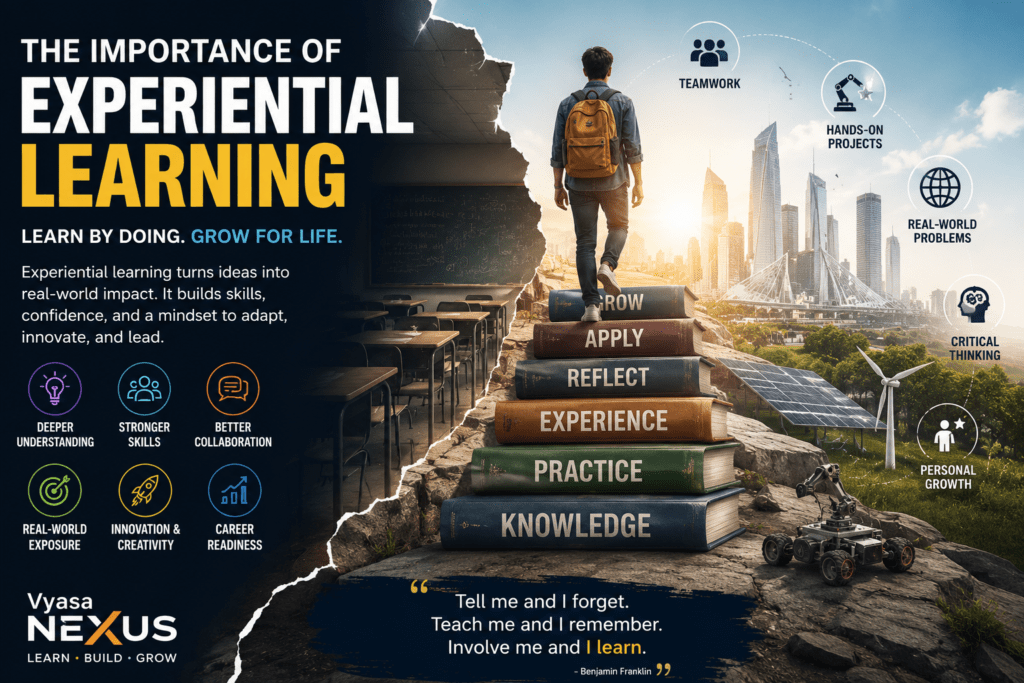
There’s an old saying: tell me and I forget, show me and I remember, involve me and I understand. Nobody knows who said it first. But every teacher, trainer, and parent has felt the truth of it.
You can read about riding a bicycle for hours. You won’t actually learn until you get on one, wobble, fall, and get back up. That’s experiential learning in a nutshell.
For decades, classrooms leaned on lectures, textbooks, and rote memorization. Students copied notes and crammed before exams. Most of it was forgotten within weeks.
Employers kept complaining too. Fresh graduates knew plenty of theory. But they struggled the moment they had to solve a real problem. That gap between what’s taught and what’s needed is exactly why experiential learning matters so much in education and training today.
What Is Experiential Learning?
Experiential learning means learning through direct experience. Then you reflect on it. That’s the whole idea.
It’s not new, either. Ancient apprenticeships worked this way. A blacksmith didn’t teach his apprentice with a book on metallurgy. He put a hammer in the apprentice’s hand. Then he corrected his form.
Psychologist David Kolb gave this idea structure. His experiential learning theory describes a four-stage cycle:
- Concrete experience — you do something
- Reflective observation — you think about what happened
- Abstract conceptualization — you draw a lesson from it
- Active experimentation — you try again with that lesson in mind
This is the Kolb experiential learning cycle. Most modern training programs, business schools, and corporate onboarding sessions still build on it.
Why Experiential Learning Matters So Much Today
The world doesn’t reward people who can recite information. It rewards people who can apply it.
Picture a student who only read about teamwork. The first time a real project falls apart, they freeze. Now picture a student who actually worked through a disagreement with a teammate. That student handles the next one with far more confidence.
Here’s why experiential learning has earned its place at the center of modern education:
It builds real understanding, not surface knowledge. Someone performs a task, makes a mistake, and corrects it. That lesson sticks. Compare that to reading a chapter and answering a quiz. One creates a memory tied to action. The other creates a memory tied to a page.
It develops skills employers actually want. Communication, problem-solving, and adaptability aren’t built through a slide deck. They’re built by doing. Think of negotiating with a difficult client in a simulation. Or debugging a program that won’t run. Or presenting an idea to a room full of skeptics.
It keeps learners engaged. Anyone who’s sat through a three-hour lecture knows how fast attention drifts. Hands-on activities hold interest because something’s at stake, even something small. There’s a right answer and a wrong answer. That changes how the brain pays attention.
It bridges the gap between classroom and career. This might be the biggest reason schools are investing so heavily in experiential education. Employers don’t want to spend a new hire’s first year teaching them how the real world works. They want graduates who already have some exposure.
Examples of Experiential Learning in Practice
Experiential learning isn’t one single method. It shows up in different forms depending on the subject and age group:
- Internships and apprenticeships — learning a trade by doing the actual work under an experienced professional
- Project-based assignments — building something real, like a working app or a business plan, and defending the choices behind it
- Simulations and role-play — common in medical schools, law schools, and sales training, where learners practice high-stakes decisions safely
- Field work and site visits — stepping outside the classroom to see theory play out, like a geology class visiting a quarry
- Service learning — volunteering for a community cause and reflecting on what it taught about responsibility and empathy
Each approach shares one thread. The learner isn’t a passive recipient of information. They’re an active participant instead. That changes how much sticks. It also changes how well it transfers to the next situation.
Experiential Learning and Career Readiness
Here’s one of the strongest arguments for experiential learning: what happens after graduation.
Picture a student who already handled a real client. Or shipped a real project. Or interned at a real company. That student walks into an interview with stories to tell, not just a transcript to show. Recruiters notice the difference almost immediately. Confidence and judgment are hard to fake. They’re nearly impossible to build without practice.
We touched on a related idea in our earlier piece on the importance of project-based learning. It looks at how hands-on assignments prepare students for the working world. Project-based learning is really one branch of the larger experiential learning tree. The two support each other well.
This also connects to a bigger shift we explored in From Consumers to Creators: The Mindset Shift That Changes Everything. Passive consumption has its place — videos, articles, lectures. But it will never replace the value of creating something yourself.
How Institutions Can Bring More Experiential Learning Into the Classroom
Adopting experiential learning doesn’t mean throwing out textbooks. It means shifting the balance. A few practical steps:
- Replace some written assignments with projects that require students to build, test, and present something tangible
- Partner with local businesses for internships, shadowing, or live projects
- Use simulations and case studies for subjects involving decisions under pressure, like management, medicine, or law
- Build in reflection time after every hands-on activity — learning often comes as much from thinking about the experience as from the experience itself
- Measure success through the quality of work students actually produce, not just exams
Career readiness programs, internship placements, and industry project simulations bring this philosophy to life. They give students a taste of real work before their first job application.
Final Thoughts
Experiential learning isn’t a passing trend. It’s a return to something education had drifted away from. People learn best by doing, failing, adjusting, and doing again.
The format doesn’t matter much — an internship, a class project, a simulation, a field trip. The outcome is the same. Learners walk away with skills they can use. Not just facts they’ll forget a week after the test.
Schools and companies keep closing the gap between education and employment. Experiential learning will only grow in importance. The classrooms of the future will look less like lecture halls. They’ll look more like workshops, studios, and job sites. That’s a change worth welcoming.