
Ask any teacher what they remember most from their own school days, and you will rarely hear “the worksheets.” More often, it is the science fair project that would not stop smoking, the mock trial that ran two hours over, or the community garden the whole class planned from scratch. These moments stick because they were not handed to students as facts to memorize. They were problems to work through. That, in a nutshell, is the promise of project-based learning, and it is why so many schools and workplaces are paying closer attention to it now.
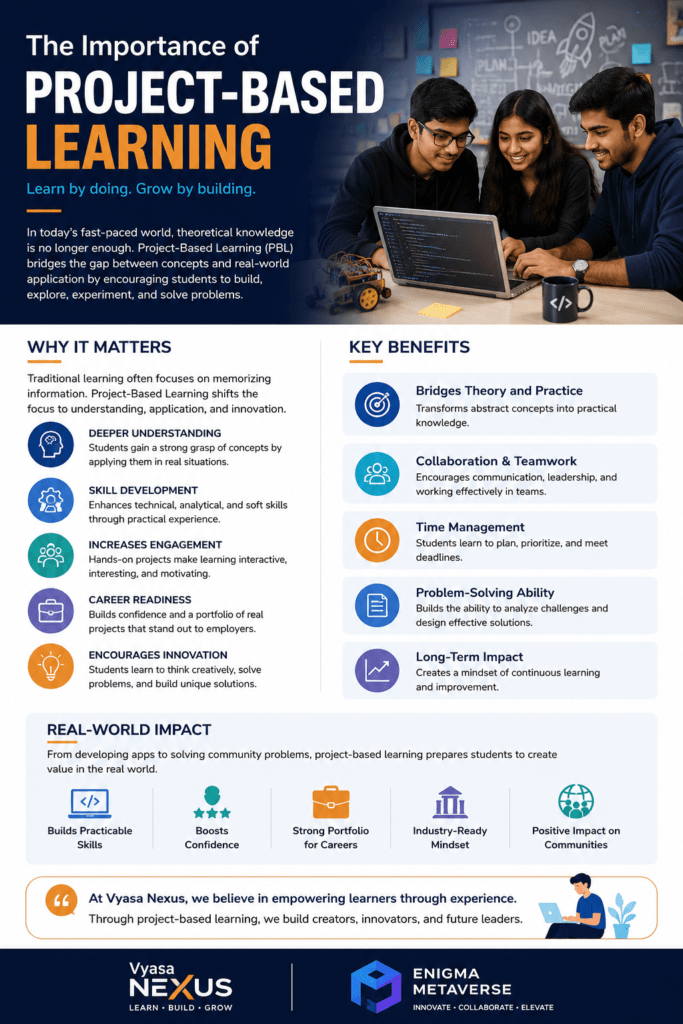
What Is Project-Based Learning?
Project-based learning, often shortened to PBL, is a teaching method built around a simple idea: students learn best by doing. Rather than sitting through a lecture and then completing a quiz on the material, students in a PBL classroom work over days or weeks on an open-ended question, challenge, or real-world problem. The project itself becomes the vehicle for learning, not a reward tacked on at the end of a unit.
A useful way to think about it: traditional instruction tends to teach first and apply second. Project-based learning flips that order. Students dig into a genuine problem, run into gaps in their knowledge along the way, and fill those gaps because they need to, not because a syllabus told them to. The learning sticks because it was earned.
A Short History Worth Knowing
Project-based learning is not a new fad dressed up in fresh branding. Its roots trace back to the American philosopher and educator John Dewey, who argued more than a century ago that education should grow out of experience rather than rote recitation. Dewey’s ideas about “learning by doing” laid the groundwork for what educators today call experiential learning, inquiry-based learning, and eventually project-based learning as a formal instructional model. What has changed since Dewey’s time is not the underlying philosophy but the urgency behind it. A century ago, memorization served students reasonably well in a stable, slower-moving economy. Today, with information available at the tap of a screen and job requirements shifting year to year, the ability to think, adapt, and problem-solve matters far more than the ability to recall.
Why Project-Based Learning Matters So Much Right Now
It builds the skills employers actually ask for
Survey after survey of hiring managers points to the same shortlist: communication, teamwork, critical thinking, and the ability to manage a project from start to finish. These are precisely the muscles that project-based learning exercises. When a group of students has to divide up research, negotiate disagreements, meet a deadline, and present findings to an audience, they are rehearsing the exact rhythms of a modern workplace. A textbook cannot teach that. A shared spreadsheet, a looming due date, and a stubborn teammate can.
It deepens understanding instead of skimming the surface
Cramming for a Friday quiz produces knowledge with a short shelf life. Working through a multi-week project forces students to return to the same concept from different angles, which is exactly how long-term memory works. Studies from the Buck Institute for Education and Lucas Education Research have found that students who learn through well-designed projects often outperform peers on standardized measures, including Advanced Placement exams, while also retaining what they learned longer after the test is over.
It raises engagement and cuts down on the “why does this matter” question
Every teacher has faced the blank stare that comes with an abstract lesson. Project-based learning tends to sidestep that problem because the work is tied to something tangible: a real audience, a real product, a real stake in the outcome. Students who are designing a public service campaign, building a working prototype, or solving a problem facing their own neighborhood have a reason to care about the outcome. That sense of ownership tends to carry over into effort, attendance, and classroom behavior.
It teaches students to sit with ambiguity
Real problems rarely come with a single correct answer printed at the back of the book. Project-based learning gives students practice at tolerating uncertainty, testing an idea, watching it fail, and trying again. That kind of resilience is difficult to teach through lecture alone, yet it is one of the more valuable habits a young person can carry into adulthood.
It supports equity in the classroom
Contrary to the assumption that hands-on work favors only a certain type of learner, research suggests that project-based learning can narrow achievement gaps rather than widen them. Students who struggle with traditional test formats, English language learners, and students facing resource gaps at home often find more entry points into a hands-on project than into a standardized worksheet. When the work draws on multiple skills, from writing and speaking to building and designing, more students find a role where they can shine.
It changes the relationship between teacher and student
In a PBL classroom, the teacher shifts from the person delivering answers to the person coaching the process. This does not lessen the teacher’s importance. If anything, it demands more skill, since guiding a room full of students through open-ended inquiry is harder than delivering a script. But teachers who make the shift frequently report stronger relationships with their students and a renewed sense of purpose in their own work.
What a Good Project-Based Learning Unit Looks Like
Not every group assignment qualifies as genuine project-based learning. The Buck Institute for Education, a widely cited authority on the subject, points to a handful of markers that separate real PBL from a dressed-up worksheet:
- A significant, open-ended question or problem sits at the center of the work, not at the end of it.
- Students have a voice in how they approach the problem, not just in coloring the final poster.
- The work connects to something outside the classroom walls, whether that is a community issue, an authentic audience, or a real client.
- Students revise their work based on feedback rather than submitting a single draft.
- The final product is shared publicly, whether with parents, a local organization, or an online audience.
Skip any one of these and the project risks becoming busywork with a title that sounds impressive.
Common Concerns About Project-Based Learning
Does PBL sacrifice content coverage for engagement? A well-planned project is built around specific standards, not in spite of them. The trick lies in the planning stage, where a teacher maps the required content onto a driving question before the unit ever begins.
Is it harder to grade fairly? Assessment in a PBL classroom does look different. Rubrics, checkpoints, and peer feedback replace a single test score, but this often gives a more accurate picture of what a student actually learned, not a less accurate one.
Does it work for younger students? Yes. Project-based learning scales down as easily as it scales up. A first grader building a model habitat for a class pet is running through the same basic process as a high schooler designing a renewable energy proposal, just at an age-appropriate level.
Bringing Project-Based Learning Into Your Classroom or Program
Getting started does not require overhauling an entire curriculum overnight. Many educators begin with a single unit, pick a driving question tied to something students already care about, and build outward from there. Community partners, local businesses, and outside mentors can add authenticity without adding much cost. Over time, as students grow accustomed to managing their own inquiry, teachers often find they can hand over more ownership and step further into the coaching role that project-based learning rewards.
Final Thought
Education has always wrestled with the gap between what happens inside a classroom and what happens once a student walks out the door. Project-based learning does not close that gap entirely, but it narrows it in a way few other methods manage. Students who learn by tackling real problems, working alongside others, and revising their thinking along the way tend to carry that habit with them long after the final bell rings. That may be the strongest argument for project-based learning: it does not just teach a subject. It teaches a way of working that lasts.
Frequently Asked Questions
What is project-based learning in simple terms?Project-based learning is a teaching method where students learn a subject by working on an extended, real-world project instead of following a traditional lecture-and-test format.
What are the main benefits of project-based learning?The main benefits include stronger critical thinking, better collaboration and communication skills, deeper retention of material, higher student engagement, and closer alignment with the skills employers look for.
Who created project-based learning?The philosophy behind project-based learning is generally credited to American educator John Dewey, whose early twentieth-century writing on experiential learning shaped much of modern PBL practice.
Is project-based learning effective for all age groups?Yes. Project-based learning can be adapted for early elementary students through high school and college, with the complexity of the driving question adjusted to fit the age group.
How is project-based learning different from a regular class project?A regular project is often assigned after content has already been taught, as a final check for understanding. Project-based learning places the project at the center of the unit from the start, so the project itself drives what students learn.