
The 2026 Job-Ready Roadmap Every Engineering Student in India Needs to Survive the Hiring Reset
Contents
SEO Strategy
SEO Title
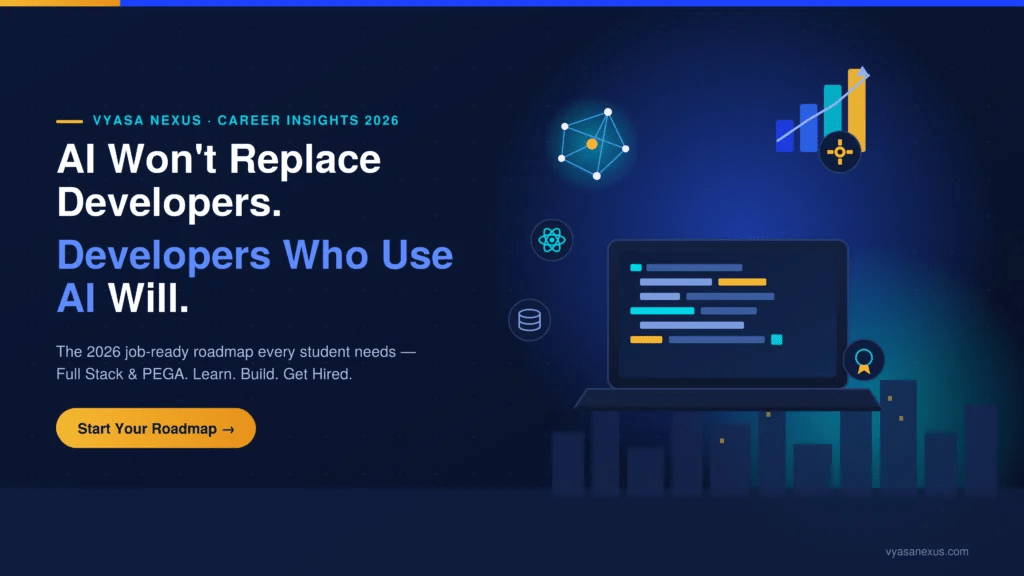
AI Won’t Replace Developers — But Developers Who Use AI Will (2026 Student Career Roadmap)
Meta Title
AI Won’t Replace Developers, But AI-Skilled Developers Will | 2026
Meta Description
AI isn’t taking developer jobs — it’s taking jobs from developers who ignore it. Here’s the 2026 skill stack, salary data & step-by-step roadmap to become job-ready in Full Stack & PEGA.
Focus Keyword
AI will replace developers
URL Slug
/blog/ai-wont-replace-developers-but-ai-skilled-developers-will-2026
Secondary Keywords
- developers who use AI
- AI vs developers 2026
- future of software jobs in India
- is full stack development worth it in 2026
- PEGA developer career
- tech jobs for freshers 2026
- AI skills for developers
- how to get an IT job without experience
Long-Tail Keywords
- will AI replace software developers in 2026
- best skills for software engineers in the age of AI
- how students can get IT jobs in India in 2026
- is it too late to learn coding in 2026
- highest paying developer skills in India 2026
- full stack vs PEGA which career is better for freshers
- how to become an AI-augmented developer
- career roadmap for engineering students after AI
Featured Snippet (Position-Zero Target)
Q: Will AI replace developers in 2026?
A: No — AI will not replace developers in 2026, but developers who use AI will replace those who don’t. AI now automates 20–40% of routine coding, testing, and documentation tasks, so companies hire fewer generalist coders and more engineers who can design, direct, and ship AI-assisted solutions. The fastest path to a job is to pair a strong fundamentals stack (Full Stack or PEGA) with practical AI literacy and a portfolio of real, shipped projects.
Internal Linking Suggestions
- Full Stack Development course curriculum — Anchor the section on full stack fundamentals → link to the Full Stack track / Explore Courses page.
- PEGA Training program — Anchor every PEGA mention → link to the PEGA course / Explore Courses page.
- Career Readiness Bootcamps — Anchor the roadmap step on interview prep → /career-readiness-bootcamps/.
- Mock Interviews & HR Preparation — Anchor ‘prepare for the human round’ → /mock-interviews-hr-preparation/.
- Internship & Project Support — Anchor ‘get real experience’ → /internship-project-support/.
- Certification + 1-month internship at Enigma Metaverse — Anchor the ‘How Vyasa Nexus Helps’ proof-of-work point.
- Free Career Counselling — Anchor the CTA + ‘pick the right lane’ line → counselling booking page.
- Career Acceleration Kits / AI Productivity Packs — Anchor the ‘become AI-augmented’ step → relevant Products pages.
External Authority References
- NASSCOM — India tech workforce & cloud economy outlook — Authority source for AI adoption, workforce growth, and cloud GDP/job projections.
- Business Standard / FindMyCollege IT Career & Skill Map 2026 — Source for the ~30% hiring contraction and fresher median salary data.
- Business Today — Indian IT hiring model & AI-native graduates — Source for selective hiring and AI-native fresher recruitment trends.
- Storyboard18 — AI and entry-level IT roles — Source for the 20–40% task-automation estimate.
- Glassdoor / SalaryExpert — PEGA developer salaries India 2026 — Source for PEGA salary ranges and role demand.
- Industry AI talent-gap reports (2026) — Source for the ~1 million AI-skilled shortfall and GenAI posting share.
The Blog Article
AI Won’t Replace Developers — But Developers Who Use AI Will (2026 Student Career Roadmap)
Rohit graduated last summer with a respectable CGPA, a degree in computer science, and a quiet confidence that the job would come. It always had, for the seniors he looked up to. He applied to forty companies. He heard back from three. He cleared none. By March, scrolling job portals at 1 a.m., he found himself asking the question that haunts almost every engineering student in India right now: “Did I just spend four years preparing for a world that no longer exists?”
If some version of that fear lives in your chest too, take a breath. You are not behind because you are not good enough. You are anxious because the rules changed in the middle of the game — and nobody handed you the new rulebook. This article is that rulebook. By the end of it, you will understand exactly why the market shifted, what companies are quietly screening for in 2026, and the precise, doable roadmap that turns a worried fresher into the kind of candidate recruiters chase.
Why This Topic Matters More in 2026 Than Ever Before
For two decades, the Indian IT story was beautifully simple: study engineering, clear a campus drive, get trained on the job, build a career. The pipeline absorbed lakhs of graduates a year without asking too many hard questions. That machine is now being rebuilt in real time, and the change is not subtle.
▶ Total IT hiring in India fell from roughly 53,800 placements in early 2024 to about 37,500 in early 2026 — a drop of more than 30% in just two years.
At the same time, the median starting salary for a fresher slipped by nearly a fifth, and the comfortable three-to-five-year experience band — historically the largest in the sector — began to thin out as routine work got automated. The headline writes itself, and plenty of newspapers have written it: AI is coming for entry-level coding jobs.
But that headline is only half true, and the missing half is where your entire future lives. AI is not erasing developers. It is erasing a specific kind of developer — the one who could only do what a machine can now do faster and cheaper. The work that remains, and the work that is exploding in volume, belongs to people who can do something the machine cannot: think in systems, judge trade-offs, talk to humans, and direct AI like a senior directs a junior.
The Industry Numbers Nobody Explained to You Properly
Let’s put real figures on the table, because vague fear is paralysing and clear data is empowering. Three forces are moving at once, and once you see them, the strategy becomes obvious.
Force 1: Routine work is being automated
Industry estimates suggest AI can already handle 20–40% of common technical tasks — boilerplate code, test-case generation, documentation, basic bug fixes. This is exactly the work that used to fill a fresher’s first year. When that work shrinks, mass fresher hiring shrinks with it. That is the painful part, and pretending otherwise helps no one.
Force 2: Specialised, AI-fluent demand is surging
While generic roles cool, a parallel market is overheating. India is staring at a shortage of close to a million AI-skilled professionals, with hundreds of thousands of open positions going unfilled. Around 90% of new AI job postings now mention generative-AI or large-language-model skills. And here is the line every student should tape to their wall: certified, practically-trained AI practitioners are reported to earn 15–50% more than peers without those skills.
▶ India faces a shortfall of nearly 1 million AI-skilled professionals — and roughly 9 out of 10 AI job listings now demand hands-on GenAI ability.
Force 3: The big firms are still hiring — just differently
Don’t believe anyone who tells you the industry has stopped recruiting freshers. India’s largest IT companies still planned to onboard tens of thousands of graduates in FY2026. The catch is who they pick. They now openly talk about hiring “AI-native” fresh graduates and being far more selective. They are not looking for more hands. They are looking for sharper ones.
Put the three forces together and the conclusion is almost gentle: the door did not close. It got narrower, and a sign went up over it that reads ‘AI-fluent builders only.’ Your job is to become the person that sign is describing.
The market trend most students miss
There is also a quieter shift happening beneath the headlines, and it works in a student’s favour if they are paying attention. Hiring is no longer concentrated only in the old metro corridors. Global Capability Centres — the in-house tech arms of global companies — are turning from back-office support into full product and engineering hubs, and they are hungry for niche, AI-aware talent. At the same time, opportunity is spilling into tier-two cities and new tech clusters, with several regions reserving the majority of fresh openings specifically for graduates. The takeaway is simple: the map of where tech jobs live is being redrawn, and the students who build the right, specific skill stack now will have more doors than the ones chasing the same crowded metro openings everyone else is fighting over.
What Students Are Getting Wrong (And Why It’s Not Your Fault)
Most students respond to this anxiety in one of three self-defeating ways. See if you recognise yourself.
- The Collector hoards certificates. Twelve Udemy courses, four ‘masterclasses’, zero shipped projects. A wall of completion badges that no recruiter ever asks about.
- The Avoider treats AI as the enemy and refuses to touch it, hoping that if they ignore the wave it will not reach the shore. It will.
- The Theorist memorises syntax and algorithms for exams but has never deployed a single thing a stranger could actually use.
None of these are character flaws. They are the predictable result of a curriculum that was designed for the old machine. Colleges optimise for marks; the market now optimises for proof. The gap between those two things is precisely the gap that swallows applicants like Rohit — and precisely the gap a focused, industry-aligned program is built to close.
“In 2026, what separates the graduate who gets hired from the one who doesn’t is rarely what they studied. It’s what they built outside the syllabus.”
What Companies Actually Want in 2026
Strip away the buzzwords and hiring managers are screening for a short, stubborn list. Understand it and you can reverse-engineer your entire preparation.
- Proof of work over proof of attendance. A live URL, a GitHub repo, a deployed app beats a transcript every time.
- AI-augmented workflow. Can you use AI tools to ship faster while still understanding and owning the output? That is the single most valuable new skill.
- Strong fundamentals. AI writes code confidently and sometimes wrongly. The engineer who knows why an answer is wrong is irreplaceable; the one who blindly copies is replaceable.
- Communication and clarity. As teams shrink and AI handles grunt work, the human premium shifts to people who can translate business problems into technical ones.
- A specialisation that pays. Generalists are being squeezed. Depth in a high-demand stack is the new safety.
The Two Specialisations Quietly Winning in India
Of all the paths a fresher could take, two stand out for the rare combination of strong demand, clear roadmaps, and real salary upside — and not by accident, they are the two Vyasa Nexus has built its training around.
Full Stack Development: the AI-amplified generalist-with-depth
Full stack is far from dead — it is being supercharged. A developer who understands the entire flow from a React interface to a Node backend to a database, and who uses AI to move through that flow at double speed, is exactly the lean, high-output engineer that shrinking teams need. The fundamentals (JavaScript, React, APIs, databases, CI/CD) remain the bedrock; AI becomes the accelerator on top. Learn the stack the right way and you are not competing with AI, you are commanding it.
PEGA: the high-paying lane most students never hear about
PEGA is one of the best-kept secrets in Indian tech careers. It is a low-code enterprise automation platform that banks, insurers, and healthcare giants depend on for mission-critical workflows — and they pay a premium for certified talent because the supply is thin. There are tens of thousands of open PEGA roles in India, concentrated in exactly the hubs where opportunity clusters: Hyderabad, Bengaluru, Chennai, Pune.
▶ PEGA freshers in India start around ₹5.5 LPA, with certified architects crossing ₹25 LPA — and over 44,000 PEGA roles are open across the country.
Because PEGA is low-code, a focused fresher can become genuinely productive in months rather than years, and certification creates an instant credibility signal that ordinary coding roles lack. For students who feel they ‘started late’ on programming, PEGA is often the fastest credible route to a premium salary.
Salary Insights: What the AI-Fluent Path Is Actually Worth
Numbers focus the mind, so here is an honest picture for 2026 India. Generic fresher coding roles have drifted down toward a median near ₹2.6 LPA — that is the squeeze everyone is feeling. But the picture transforms the moment you add specialisation and AI fluency.
- AI-augmented full stack developers command well above the generic baseline, especially with a strong deployed portfolio.
- Certified PEGA developers start at a premium and scale fast — senior and lead architects routinely earn in the ₹20–25 LPA-plus range.
- AI/GenAI-specialised engineers in hubs like Hyderabad and Bengaluru report some of the steepest fresher-to-senior salary jumps in the country.
The lesson is not ‘coding pays badly now.’ It is that the market stopped paying for effort and started paying for leverage — and leverage means depth plus AI.
Future Scope: Where This Goes Next
Cloud alone could account for a meaningful slice of India’s GDP and generate crores of new jobs this decade. The country’s semiconductor push, the explosion of Global Capability Centres turning into product hubs, and AI-first startups raising record funding all point one way: the demand is not vanishing, it is migrating toward people who can build with modern tools. The students who position themselves now — while the rest panic — will spend the next decade riding a wave instead of fighting an undertow.
Real-World Proof: The Two Graduates
Remember Rohit from the start? Picture a parallel student, Anjali, same college, same CGPA. The only difference is what she did after graduation. While Rohit collected rejection emails, Anjali spent four focused months on a structured full-stack track, shipped three real projects, learned to pair with AI tools to debug and accelerate, did a one-month industry internship, and walked into interviews with a portfolio she could demo live.
Anjali did not have more talent. She had a map and the discipline to follow it. When an interviewer asked her to walk through one of her projects, she did not recite definitions — she pulled up a live URL, showed the feature she was proudest of, explained the bug that nearly broke it, and described exactly how she used an AI assistant to diagnose the problem faster while still understanding the fix herself. That single answer told the recruiter everything a transcript never could: she can build, she can think, and she can work the way modern teams actually work. That is the entire difference between the two outcomes — and it is completely learnable. Rohit’s story is not a tragedy; it is just an unfinished one. With the right roadmap, his next six months can look exactly like Anjali’s last six.
Your Actionable 2026 Roadmap
Here is the sequence that turns anxiety into employability. Follow it in order; each step compounds the last.
- Pick one lane and commit. Choose Full Stack or PEGA. Depth beats a scattered resume of half-learned skills.
- Master the fundamentals properly. The non-negotiable base — for full stack: JavaScript, React, APIs, databases, CI/CD; for PEGA: case management, data models, integrations, and certification prep.
- Become AI-augmented, not AI-dependent. Use AI to write, debug, and learn faster — but always understand the output well enough to defend it in an interview.
- Build in public. Ship three real projects with live links. A portfolio is the new resume.
- Get real experience. A genuine internship on a real product converts a student profile into a hireable one.
- Prepare for the human round. Mock interviews, HR readiness, and the ability to explain your thinking clearly are now differentiators, not afterthoughts.
How Vyasa Nexus Closes the Gap
Everything above describes the destination. The reason most students never reach it is not motivation — it is the absence of a structured path, real projects, and someone in their corner. That is the exact gap Vyasa Nexus was built to close, and it does it through a simple, deliberate model: learn, build, get hired.
- Industry-aligned Full Stack and PEGA curricula that teach the fundamentals the market actually rewards, with AI woven into the workflow rather than feared.
- Real industry use cases, problem sets, and mock tests so you practise on the kind of work companies hire for — not just exam questions.
- Career Readiness Bootcamps, mock interviews, and HR preparation that fix the human round most students fumble.
- A Vyasa Nexus certification plus a one-month internship at Enigma Metaverse, so you graduate with proof of work and real experience, not just a completion badge.
- Online and offline flexibility, and free career counselling to help you pick the right lane before you spend a single rupee or a single month going the wrong way.
In other words, Vyasa Nexus is the bridge between the curriculum that prepared you for the old machine and the market that runs on the new one.
The Student Success Framework
Boil the entire roadmap down and it fits in five words you can remember on your worst day: Choose. Master. Build. Prove. Apply. Choose one specialisation. Master its fundamentals. Build real projects with AI as your accelerator. Prove it with an internship and a portfolio. Apply with the confidence of someone who has done the work, not just attended the lectures.
A Final Word to the Student Reading This at 1 a.m.
The fear you feel is real, but it is pointing you in the wrong direction. It tells you that the future is closing. The data says the opposite: the future is opening fast for a specific kind of person, and that person is not a genius or a prodigy. It is simply a student who picked a lane, learned the fundamentals, made AI their teammate, and shipped real things while everyone else was panicking.
AI will not replace you. But a developer who learned to work with AI very well — someone who, six months from now, could be you — absolutely might replace the version of you that waited. The best time to start was at the beginning of your degree. The second best time is tonight.
Frequently Asked Questions
Q: Will AI replace developers in 2026?
A: No. AI will not replace skilled developers in 2026, but developers who use AI effectively will out-compete those who don’t. AI automates 20–40% of routine coding and testing, so companies now hire fewer generalist coders and more engineers who can direct AI, judge its output, and ship real solutions.
Q: Is full stack development still worth learning in the age of AI?
A: Yes. Full stack development is more valuable when paired with AI, because lean teams need engineers who understand the entire flow from frontend to backend to database and can move through it faster using AI tools. The fundamentals stay essential; AI becomes the accelerator on top.
Q: Why are PEGA developers among the highest paid in India?
A: PEGA is a low-code enterprise automation platform that banks, insurers, and healthcare firms rely on, and certified talent is in short supply. That scarcity means premium pay — freshers start around ₹5.5 LPA and certified architects can cross ₹25 LPA, with tens of thousands of roles open in hubs like Hyderabad and Bengaluru.
Q: How can a fresher get an IT job in 2026 without experience?
A: Pick one specialisation (Full Stack or PEGA), master its fundamentals, learn to build with AI tools, ship three real projects with live links, and complete a genuine internship. A portfolio plus real experience now matters far more than a certificate or transcript alone.
Q: Is it too late to start learning to code in 2026?
A: No. It is not too late, but the approach must change. Instead of collecting certificates, focus on one in-demand stack, build deployable projects, and develop AI-augmented workflows. Low-code paths like PEGA can make students productive in months, which is ideal for those who feel they started late.
Q: What skills do companies actually screen for now?
A: Proof of work over proof of attendance, AI-augmented workflow ability, strong fundamentals, clear communication, and a high-demand specialisation. Recruiters in 2026 want sharper engineers, not simply more hands.
FAQ Schema (JSON-LD)
Paste inside a <script type=”application/ld+json”> tag in the page head.
{
“@context”: “https://schema.org”,
“@type”: “FAQPage”,
“mainEntity”: [
{
“@type”: “Question”,
“name”: “Will AI replace developers in 2026?”,
“acceptedAnswer”: {
“@type”: “Answer”,
“text”: “No. AI will not replace skilled developers in 2026, but developers who use AI effectively will out-compete those who don’t. AI automates 20–40% of routine coding and testing, so companies now hire fewer generalist coders and more engineers who can direct AI, judge its output, and ship real solutions.”
}
},
{
“@type”: “Question”,
“name”: “Is full stack development still worth learning in the age of AI?”,
“acceptedAnswer”: {
“@type”: “Answer”,
“text”: “Yes. Full stack development is more valuable when paired with AI, because lean teams need engineers who understand the entire flow from frontend to backend to database and can move through it faster using AI tools. The fundamentals stay essential; AI becomes the accelerator on top.”
}
},
{
“@type”: “Question”,
“name”: “Why are PEGA developers among the highest paid in India?”,
“acceptedAnswer”: {
“@type”: “Answer”,
“text”: “PEGA is a low-code enterprise automation platform that banks, insurers, and healthcare firms rely on, and certified talent is in short supply. That scarcity means premium pay – freshers start around Rs.5.5 LPA and certified architects can cross Rs.25 LPA, with tens of thousands of roles open in hubs like Hyderabad and Bengaluru.”
}
},
{
“@type”: “Question”,
“name”: “How can a fresher get an IT job in 2026 without experience?”,
“acceptedAnswer”: {
“@type”: “Answer”,
“text”: “Pick one specialisation (Full Stack or PEGA), master its fundamentals, learn to build with AI tools, ship three real projects with live links, and complete a genuine internship. A portfolio plus real experience now matters far more than a certificate or transcript alone.”
}
},
{
“@type”: “Question”,
“name”: “Is it too late to start learning to code in 2026?”,
“acceptedAnswer”: {
“@type”: “Answer”,
“text”: “No. It is not too late, but the approach must change. Instead of collecting certificates, focus on one in-demand stack, build deployable projects, and develop AI-augmented workflows. Low-code paths like PEGA can make students productive in months, which is ideal for those who feel they started late.”
}
},
{
“@type”: “Question”,
“name”: “What skills do companies actually screen for now?”,
“acceptedAnswer”: {
“@type”: “Answer”,
“text”: “Proof of work over proof of attendance, AI-augmented workflow ability, strong fundamentals, clear communication, and a high-demand specialisation. Recruiters in 2026 want sharper engineers, not simply more hands.”
}
}
]
}
Social Media Content
LinkedIn Post
I’ll be blunt with every engineering student reading this:
AI is not going to take your job.
A developer who learned to use AI will.
The data from 2026 is uncomfortable but clarifying. IT hiring in India is down ~30% in two years. Median fresher salaries have slipped. Routine coding, testing, and documentation — the work that used to fill a fresher’s first year — is now 20–40% automatable.
But here’s the half nobody puts in the scary headline:
→ India is short nearly 1 MILLION AI-skilled professionals.
→ ~90% of AI job postings now demand hands-on GenAI ability.
→ Certified, AI-fluent developers earn 15–50% more than peers.
The door didn’t close. It got narrower, with a sign over it: ‘AI-fluent builders only.’
If you’re a student, your roadmap is simple (not easy):
1. Pick one lane — Full Stack or PEGA.
2. Master the fundamentals properly.
3. Make AI your teammate, not your crutch.
4. Ship 3 real projects. Portfolio > transcript.
5. Get a real internship.
You don’t need to be a genius. You need a map and the discipline to follow it.
We wrote the full 2026 roadmap on the blog — link in comments. 👇
#AI #SoftwareDevelopment #CareerGrowth #FullStack #PEGA #TechJobs #Students #VyasaNexus
Instagram Caption
AI won’t replace you. 🚫🤖
A developer who USES AI might. ⚡
The 2026 reality for students, in 3 lines:
📉 IT hiring down ~30% in 2 years
🔥 ~1 MILLION AI-skilled jobs unfilled
💸 AI-fluent devs earn 15–50% more
The door didn’t close. It got narrower. 🚪
Here’s how you walk through it 👇
Pick a lane (Full Stack or PEGA) → master the basics → build with AI → ship real projects → intern → get hired. ✅
Save this. Send it to the friend who’s stressing at 1 a.m. 💛
Full roadmap on our blog — link in bio.
#AI #coding #fullstack #pega #techcareers #engineeringstudents #jobsearch #careeradvice #vyasanexus #futurejobs #learntocode #studentlife
Twitter / X Thread
1/7
AI won’t replace developers.
But developers who use AI will replace the ones who don’t.
Here’s the uncomfortable 2026 data — and the exact roadmap for students who refuse to be left behind. 🧵
2/7
First, the fear is real.
India’s IT hiring fell ~30% in 2 years. Median fresher salaries slipped. AI now automates 20–40% of routine coding, testing & docs — the exact work that filled a fresher’s first year.
That’s the half the headlines love.
3/7
Now the half they bury:
→ India is short ~1 MILLION AI-skilled pros
→ ~90% of AI job posts demand GenAI skills
→ AI-fluent, certified devs earn 15–50% more
The door didn’t close. It narrowed. Sign over it: ‘AI-fluent builders only.’
4/7
Why students get stuck (none of it your fault):
• The Collector hoards certificates, ships nothing
• The Avoider refuses to touch AI
• The Theorist memorises syntax, deploys nothing
Colleges optimise for marks. The market optimises for proof.
5/7
Two lanes quietly winning in India:
1️⃣ Full Stack — AI-amplified, lean, high-output
2️⃣ PEGA — low-code, premium pay, thin supply. Freshers ~₹5.5 LPA → architects ₹25 LPA+. 44,000+ open roles.
6/7
The roadmap that turns panic into a job offer:
1. Pick ONE lane
2. Master fundamentals
3. Use AI — don’t depend on it
4. Ship 3 real projects
5. Get a real internship
6. Nail the human round
Portfolio > transcript. Every time.
7/7
You don’t need to be a prodigy.
You need a map and the discipline to follow it.
We wrote the full 2026 student roadmap — Full Stack & PEGA, salary data, the works.
Read it. Then start tonight. 👇
[blog link]
WhatsApp Promotional Copy
AI won’t replace developers — but devs who use AI will. 🤖⚡
Engineering student worried about IT jobs in 2026? You’re not behind — the rules just changed.
📉 IT hiring down ~30%
🔥 ~1 million AI jobs unfilled
💰 AI-fluent devs earn 15–50% more
We broke down the exact roadmap to become job-ready — Full Stack & PEGA, salary data, and step-by-step actions.
👉 Read the full guide: [blog link]
📞 Free career counselling to pick your lane: [link]
_Vyasa Nexus — Learn. Build. Get Hired._
Email Newsletter
Subject: AI won’t replace you. (But this will.)
Preview: The 2026 data is scary. The roadmap out of it isn’t.
Hi {first_name},
Let’s be honest about something every engineering student is feeling right now.
India’s IT hiring is down nearly 30% in two years. Fresher salaries have slipped. And AI now handles 20–40% of the routine coding work that used to be a fresher’s first job.
If that scares you, good — it means you’re paying attention. But here’s what the headlines leave out:
• India is short nearly 1 MILLION AI-skilled professionals.
• Around 90% of AI job postings now demand hands-on GenAI skills.
• AI-fluent, certified developers earn 15–50% more than their peers.
The door didn’t close. It got narrower — and it now reads ‘AI-fluent builders only.’
We just published a full 2026 roadmap that shows students exactly how to become that kind of builder: which lane to pick (Full Stack or PEGA), the fundamentals that still matter, how to use AI without becoming dependent on it, and how to prove it with real projects and a real internship.
👉 Read the complete roadmap: [BLOG LINK]
And if you’d like help choosing the right lane before you invest a single month going the wrong way, our team offers free career counselling — no pressure, just clarity.
📞 Book free counselling: [COUNSELLING LINK]
You don’t need to be a genius. You need a map.
Learn. Build. Get hired.
— The Vyasa Nexus Team
Lead Generation / CTA Assets
1) Blog CTA Banner
Headline: Don’t Just Read About the Future — Get Built For It.
Body: The students who act now will spend the next decade ahead of the ones who waited. Vyasa Nexus turns anxious freshers into AI-fluent, job-ready Full Stack and PEGA developers — with real projects, a certification, and a one-month industry internship.
Button: Explore Courses →
2) Newsletter Signup CTA
Headline: Get the 2026 Career Edge in Your Inbox.
Body: Weekly, no-fluff insights on AI skills, in-demand tech careers, salary trends, and student success stories — written for engineering students who refuse to be left behind.
Button: Subscribe Free →
3) Contact CTA
Headline: Have a Question? Talk to a Human, Not a Chatbot.
Body: Whether you’re choosing between Full Stack and PEGA or wondering if you’ve started too late, our team is here to give you honest, personalised guidance.
Button: Contact the Vyasa Nexus Team →
4) Course Inquiry CTA
Headline: Two Lanes. One Future-Proof Career.
Body: Industry-aligned Full Stack Development and PEGA programs — built around the exact skills companies are hiring for in 2026, with AI woven into the workflow. Online or offline.
Button: Enquire About Courses →
5) Free Counselling CTA
Headline: Not Sure Which Path Is Right for You? Let’s Figure It Out — Free.
Body: Book a free career counselling session and get a clear, personalised roadmap before you spend a single rupee or a single month going the wrong way. No pressure. Just clarity.
Button: Book Free Career Counselling →
Image Prompt (Midjourney / DALL·E / Firefly)
A premium, ultra-realistic 16:9 EdTech blog hero banner, 4K resolution, cinematic and aspirational. CENTER-RIGHT: a confident young Indian engineering student (early 20s, smart-casual) seated at a sleek modern desk, working intently on a laptop that glows with a clean, modern code editor interface (visible but tasteful syntax-highlighted code, not gibberish). FLOATING AROUND THE LAPTOP: translucent blue-and-cyan AI holograms — a glowing neural-network node sphere, soft GenAI chat bubbles, and subtle data-visualisation panels (rising bar charts, line graphs, a circular progress ring) suggesting career growth. UPPER AREA: an upward-sweeping growth arrow and small glowing technology icons (React atom, database cylinder, cloud, gear/automation, certificate badge) arranged like a constellation. BACKGROUND: a softly blurred futuristic city skyline at blue hour with warm window lights and faint holographic data streams, conveying opportunity and the future of work. COMPOSITION: rule-of-thirds, student on the right third, with the LEFT THIRD kept deliberately clean and uncluttered (a darker gradient negative-space zone) as a TYPOGRAPHY PLACEMENT AREA for the headline. LIGHTING: cinematic, soft key light on the student’s face, cool electric-blue rim lighting from the holograms, warm amber accents from the city to balance the palette. CAMERA: 35mm look, slight low-to-eye-level hero angle, shallow depth of field, crisp foreground subject with dreamy bokeh background. COLOR GRADING: premium corporate palette — deep navy and indigo base, electric blue and cyan accents, with warm gold highlights; high contrast, clean, modern, marketing-grade. MOOD: optimistic, ambitious, future-ready. Photorealistic, sharp, website hero-banner quality. Negative: no clutter in the left third, no distorted hands, no unreadable text, no logos, no watermark, no childish cartoon style.