
What is Data Analytics?
In today’s digital world, data is everywhere—from the apps we use to the transactions we make daily. But raw data alone doesn’t create value. The real power lies in Data Analytics, which helps transform data into meaningful insights that drive smarter decisions.
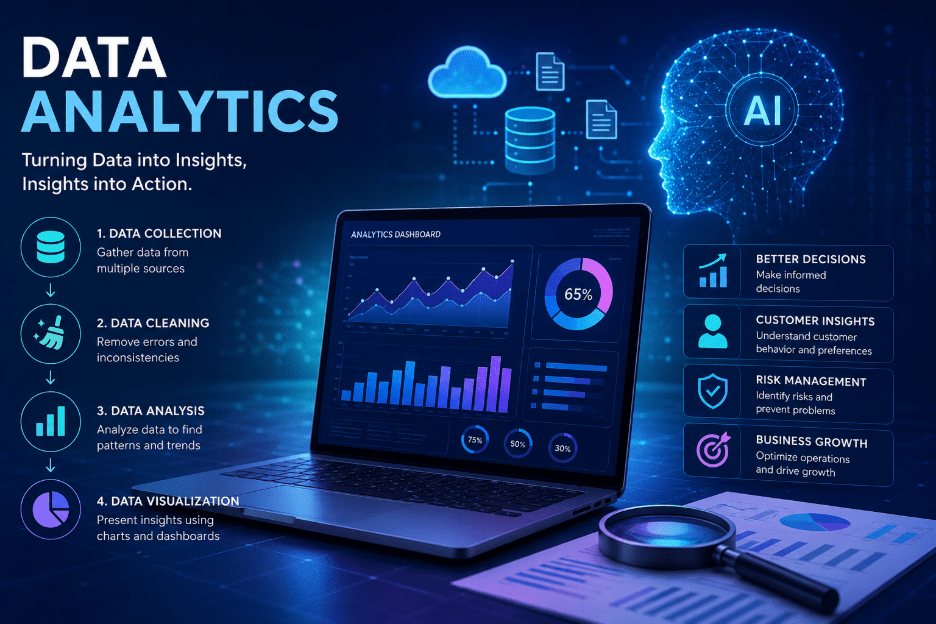
📊 Understanding Data Analytics
Data Analytics is the process of examining, cleaning, transforming, and interpreting data to uncover patterns, trends, and useful information. It enables organizations and individuals to make informed decisions based on facts rather than assumptions.
Simply put:
👉 Data Analytics turns raw data into actionable insights.
🔍 Types of Data Analytics
Data analytics is typically divided into four main types:
1. Descriptive Analytics
This answers the question: “What happened?”
- Example: Monthly sales reports
- Focus: Historical data analysis
2. Diagnostic Analytics
This answers: “Why did it happen?”
- Example: Analyzing why sales dropped
- Focus: Finding root causes
3. Predictive Analytics
This answers: “What might happen next?”
- Example: Forecasting future sales trends
- Uses machine learning and statistical models
4. Prescriptive Analytics
This answers: “What should we do?”
- Example: Recommending marketing strategies
- Focus: Decision-making guidance
🛠️ Key Components of Data Analytics
- Data Collection – Gathering data from sources like databases, APIs, or sensors
- Data Cleaning – Removing errors and inconsistencies
- Data Analysis – Applying statistical and logical techniques
- Data Visualization – Presenting insights using charts and dashboards
📈 Importance of Data Analytics
Data analytics plays a crucial role across industries:
- Business Growth – Helps identify opportunities and optimize operations
- Better Decision-Making – Supports data-driven strategies
- Customer Insights – Understand user behavior and preferences
- Risk Management – Detects fraud and predicts risks
🌍 Real-World Examples
- E-commerce: Recommending products based on user behavior
- Healthcare: Predicting diseases and improving patient care
- Finance: Fraud detection and risk analysis
- Education: Personalized learning experiences
🧠 Tools Used in Data Analytics
Some popular tools and technologies include:
- Excel – Basic data analysis
- SQL – Database querying
- Python / R – Advanced analytics and machine learning
- Power BI / Tableau – Data visualization
🚀 Future of Data Analytics
With the rise of Artificial Intelligence (AI) and Big Data, data analytics is evolving rapidly. Organizations are increasingly relying on real-time analytics and automation to stay competitive.
✍️ Conclusion
Data Analytics is no longer optional—it’s essential. Whether you’re a student, professional, or business owner, understanding data analytics can open doors to new opportunities and smarter decision-making.
👉 In a data-driven world, those who understand data will lead the future.